


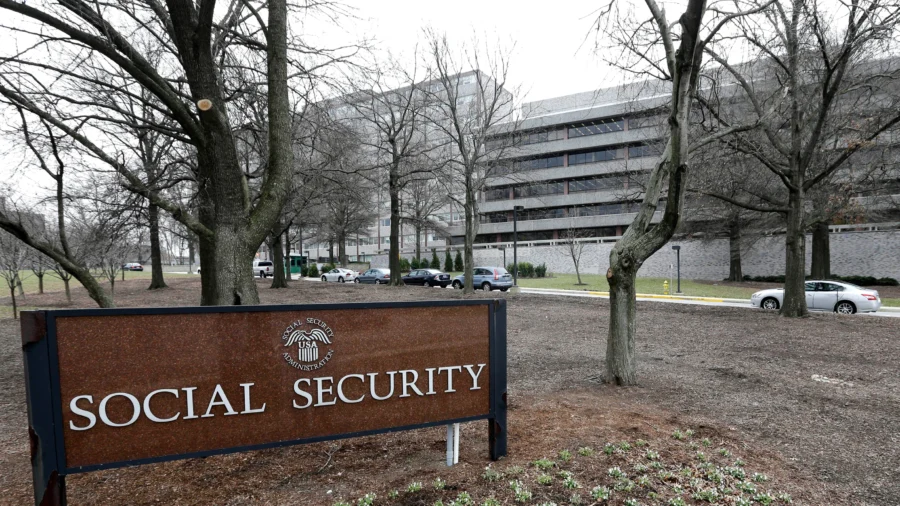
With Social Security recipients facing potential benefit cuts of about 22 percent within six years, lawmakers are advancing competing plans to shore up the program, but none has gained significant momentum in Congress.
The Old-Age and Survivors Insurance fund alone is projected to run dry in the fourth quarter of 2032, at which point only 78 percent of benefits could be paid. Reserves fell by $160 billion in 2025 to $2.56 trillion, and the report noted that the program's costs have exceeded non-interest income every year since 2010.
Social Security Commissioner Frank J. Bisignano said in a media release June 9 that "it is important for lawmakers and the Social Security Administration to work together to ensure the trust funds continue to provide financial stability now and for future generations."
Rather than dictating specific benefit or tax changes, the bill would direct the independent Social Security Advisory Board to draft legislation guaranteeing trust fund solvency for 50 years, which would then move through the Senate Finance and House Ways and Means committees before facing votes requiring a three-fifths Senate majority and a simple House majority.
Durbin said in the release that the proposal gives Congress "our chance to agree on a bipartisan process to rescue Social Security this year," adding that "we were elected to solve problems—and there's no greater problem than the solvency and future of Social Security.”
More recently, Cassidy said this week that Durbin approached him about pushing the measure now that Durbin is retiring, recalling the Illinois senator saying, "Bill, I'm leaving the Senate soon. We need to take a ride at it.”
Cassidy also voiced frustration at resistance to the bill, saying in a floor speech on Aug. 5, "For some people, the time to do Social is never. Don't disturb Congress. They don't want to take a tough vote. Even if that vote only sets up a process.”
The advocacy group AARP has opposed the bill, arguing it would "fast-track" changes to Social Security through a process that restricts amendments and imposes rigid deadlines. The proposal has drawn backing from the Peterson Solutions Fund, the Bipartisan Policy Center, Third Way and the Committee for a Responsible Federal Budget.
Separately, Cassidy has teamed with Kaine on a plan to create a $1.5 trillion government-seeded fund invested in stocks and other higher-risk assets over 75 years, with proceeds eventually repaying the Treasury Department.
Cassidy estimated the fund could cover about two-thirds of the program's projected $26.6 trillion funding gap, meaning tax hikes or benefit cuts would still be needed but could be smaller. He described the plan's benefit to Congress, saying, "the advantage of the 'Save Our Seniors Fund' is that it lessens your political battle."
But the Committee for a Responsible Federal Budget cautioned that the approach "is a dangerous, debt-funded gamble that would come with huge risks and costs.”
Other lawmakers are focused on the payroll tax cap, which currently exempts income above $184,500 from Social Security taxation. Sens. Elizabeth Warren (D-Mass.) and Bernie Moreno (R-Ohio) have called for eliminating the cap entirely, asking in the New York Times, "Why should a middle-class nurse pay a larger share of her paycheck than a wealthy corporate lawyer?"
The Peter G. Peterson Foundation estimates removing the cap could generate more than $3.2 trillion for the trust fund over a decade. A narrower approach from Sen. Sheldon Whitehouse (D-R.I.) and Rep. Brendan Boyle (D-Pa.) would apply the tax only to income above $400,000, also boosting Medicare contributions from top earners.
A bill backed by Sen. Bernie Sanders (I-Vt.) and Rep. Val Hoyle (D-Ore.) would lift the tax cap for earnings above $250,000—including capital gains and dividends—while raising benefits by roughly $2,400 annually and boosting cost-of-living adjustments. The House version has 39 Democratic co-sponsors. Sanders wrote to colleagues that requiring the wealthy "to pay the same percentage of their income into Social Security as tens of millions of working people is how we extend Social Security's solvency for generations to come.”