

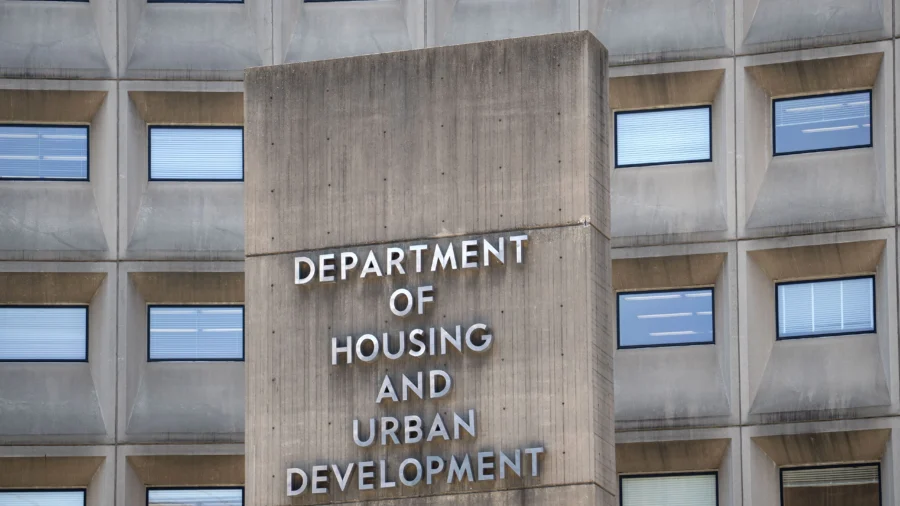
The Department of Housing and Urban Development (HUD) has reported billions of dollars in improper payments.
HUD released its annual Agency Financial Report to Congress earlier this month. As part of the internal reporting, HUD included reporting on payment integrity. Using advanced data analytics, the department said it analyzed the entire database of rental assistance from fiscal year 2024 and found nearly $6 billion in payments made to housing projects and tenants that did not qualify.
“HUD will continue investigating the shocking results and will take appropriate action to hold bad actors accountable," he said.
He added that his department will continue to strengthen program integrity so that tax dollars benefit the communities they're intended for.
Among the over $33 billion in disbursements for tenant-based rental assistance (TBRA)—private vouchers given to individual tenants—HUD found $1.1 billion in awards given to inactive System for Award Management (SAM.gov) registrations. Some $136 million in disbursements went to 7,486 individuals with non-conforming Social Security Numbers; another $69.3 million was disbursed to 8,196 deceased tenants. "Payments Exceeding Reasonable Thresholds" to some 75,955 tenants totaled $127.5 million.
The total of $1.48 billion in potentially erroneous payments was an error rate of 4.36 percent, the report said.
Among project-based rental assistance (PBRA)—subsidies given to the rental properties themselves—HUD found some $4.1 billion awarded to inactive SAM.gov registrants; $14.3 million was awarded to 1,986 individuals with non-conforming SSNs; 21,159 deceased tenants received $7.7 million in payments; and $160.1 million in Payments Exceeding Reasonable Thresholds were disbursed to 89,438 individuals.
The total error was $4.3 billion out of $16.5 in total disbursements, a potential error rate of 26.4 percent.
The report put responsibility on the last administration for sending out checks without verifying the details of these transactions. It also blamed the design of HUD's rental assistance programs that considerable trust in non-federal entities, like local housing authorities, contract administrators, landlords, "to accurately assess tenant eligibility for two of the most complex rental assistance programs."
The report also noted that HUD lacks the right tools and systems to check how these entities were enforcing the complex rules of rental assistance.
Many of the problems cited are not new issues.
HUD has not been able to calculate estimates of improper payments in its two highest-risk program, TBRA and PBRA for the last eight years. These estimates are required by law. The last year such a report was produced was 2016, when HUD found roughly $1.7 billion in improper payments to these programs.
The report also found a larger, more systemic issue across the department.
"Upon my return and review of the financial infrastructure, I noted a deterioration in HUD’s internal controls," Principal Deputy Chief Financial Officer Irving L. Dennis said in a message included with the report. He served as HUD CFO during the first Trump administration.
Dennis said they were unable to give reasonable assurance that HUD would pass a financial audit but stated the department was working on enhancing improper payments systems and remediating the internal issues.