More than 900 earthquakes have shaken a remote island chain in southern Japan over the past two weeks, leaving residents exhausted and anxious as seismic activity continues with no clear end in sight, according to the Japan Meteorological Agency (
JMA).
The JMA reported during an emergency
news conference that the series of tremors began on June 21 and has persisted, with the total number of quakes surpassing 900 as of Wednesday afternoon, according to Ayataka Ebita, director of the agency’s earthquake and tsunami observation division.
“Seismic activity has been very active in the seas around the Tokara island chain since June 21,” Ebita told reporters. “As of 4 p.m. today, the number has exceeded 900,” he said, adding that the agency could not predict when the earthquakes would subside.
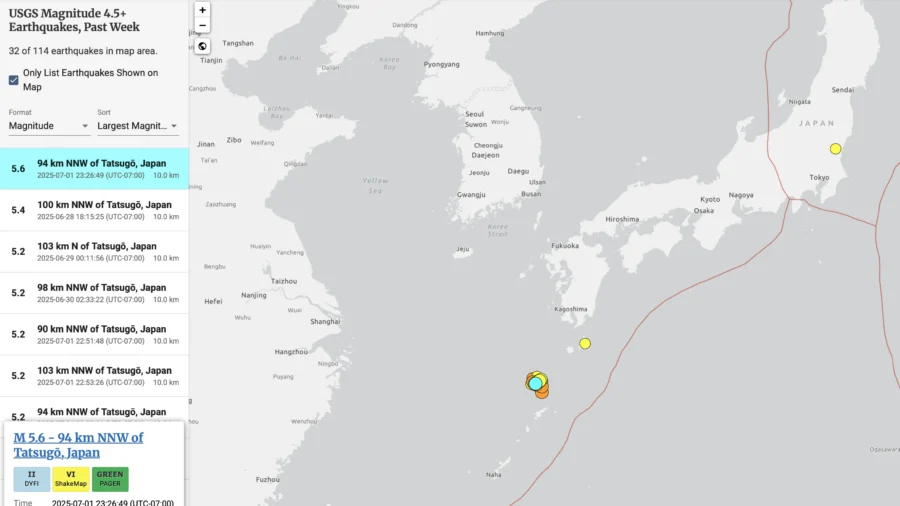
The latest and strongest jolt, a magnitude 5.5 quake, struck the Tokara Islands at around 3:30 p.m. local time on Wednesday. The U.S. Geological Survey
registered a similar 5.6-magnitude quake in the same area, a string of 12 islands stretching between Japan’s main island and Okinawa.
All of the quakes have measured at least 1.5 on the Japanese seismic scale, making them noticeable to residents.
Despite the persistent shaking, no major damage has been reported so far. However, the psychological toll on the roughly 700 residents living on seven of the 12 inhabited islands has been significant, according to Tokara village officials.
The village reported on its website that residents have struggled to sleep, due to the persistent earthquakes as well as constant interviews by reporters on the spot.
The village, in its
statement online, asked reporters to be mindful of excessive inquiries and interviews on site. Residents can contact the Toshima Village Office at (009-222-2101) to check on the earthquake situation.
A similar episode of intense seismic activity occurred in September 2023, when 346 earthquakes were recorded in the Tokara area. The cause of the current uptick in earthquakes has not been determined, though Ebita noted that the formation of a new volcanic island can sometimes follow clusters of small, localized tremors.
Japan sits atop four major tectonic plates along the Pacific “Ring of Fire” and is among the world’s most seismically active countries, experiencing about 1,500 earthquakes annually and accounting for roughly 18 percent of global seismic activity.
The recent spike in seismic activity has
coincided with a surge of public anxiety fueled by a widely shared prophecy from Japanese manga artist and self-proclaimed clairvoyant Ryo Tatsuki. Tatsuki, known for her 1999 book “The Future I Saw,” gained notoriety after her writings appeared to predict the March 2011 earthquake and tsunami, one of Japan’s worst natural disasters.
In her 2021 reprint, Tatsuki described a vivid dream foreseeing a massive earthquake and tsunami in July 2025, with catastrophic consequences for Japan and neighboring regions.
Her latest edition has been
interpreted by some to indicate a disaster happening specifically on July 5, but Tatsuki has denied this. She has tried to dampen the speculation, saying in a statement issued by her publisher that she is "not a prophet."
The prophecy, which details a violent eruption in the Pacific Ocean and a tsunami “three times larger” than the one in 2011, has gone viral across East Asia. The prediction has led to a wave of canceled trips to Japan, particularly among tourists from China, Hong Kong, and Taiwan.
Greater Bay Area Airlines in Hong Kong reduced flights to several Japanese destinations after bookings dropped by about 30 percent, according to Hiroki Ito, the airline’s Japan office head.
“After looking into it, we found that many people in Hong Kong believed the ‘prophecy.’ With further declines expected as July approaches, we decided to scale back flights in order to maintain the viability of the routes,” Ito
said.
Social media has amplified the sense of unease, with more than 1,400 YouTube videos about the “July 2025” prediction garnering over 100 million views, according to
Japaninsides.
On TikTok, related content has been viewed more than 40 million times. In Chinese-speaking regions, hundreds of videos have further fueled concerns, with some travelers expressing a preference to “believe that it’s true,” rather than risk their safety.
In response, Japanese officials have attempted to calm public fears. The Japan Meteorological Agency
stated, “No unusual seismic patterns have been detected that would warrant a forecast for a major event in July 2025,” and urged the public not to let “unverified sources” influence safety decisions.
The Cabinet Office’s Disaster Prevention division also said in an April 24
post on X the importance of preparedness, noting that “with current scientific knowledge, it is still difficult to predict the specific time and location of an earthquake.” The agency advised residents and visitors to confirm evacuation sites and routes and to secure furniture in advance.
Tatsuki, for her part, said she views the heightened attention as a positive sign. “The high level of interest everyone is showing is proof of growing awareness of disaster prevention, and I’m taking it as a positive thing. I hope that this interest will lead to safety measures and preparedness,” she
wrote in response to questions about the impact of her book.
Japan, situated on the Pacific Ring of Fire, is one of the world’s most earthquake-prone nations.