


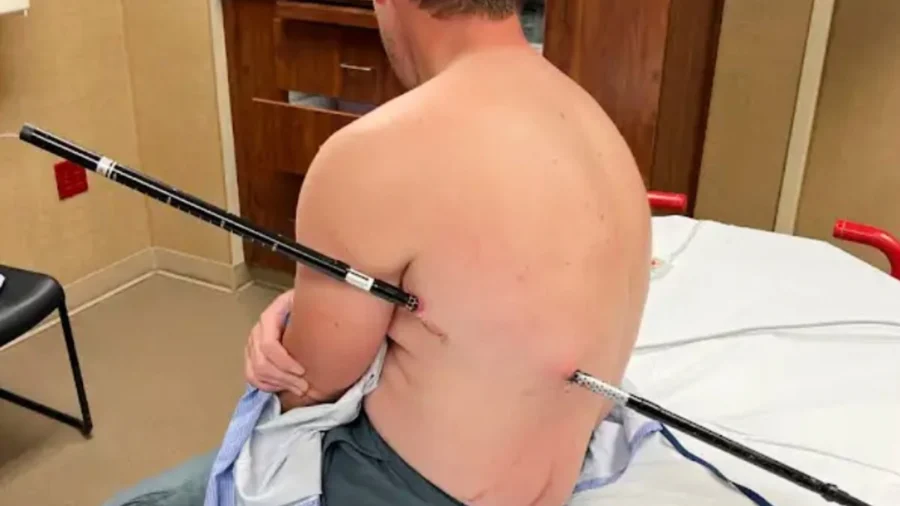
A 32-year-old nurse who works in wound care at a Billings, Montana hospital, found himself on the other side of care when he slipped, fell, and in the process, stabbed himself with a trekking pole while crossing Montana’s ominous Froze-to-Death Plateau.
As they approached the top of Montana’s highest peak, the climb took an unusual and dangerous turn for David Cifaldi, who was accompanied by two hiker friends.
Cifaldi’s 44-inch steel-tipped javelin passed through his body underneath Cifaldi’s left arm. However, it missed vital organs and emerged out of his back.
“I was like, ‘We’ve got to get off this mountain.’ And they’re both like, ‘I don’t know about that,’” Cifaldi said of his friends’ initial response. “I’m pretty confident this is outside my chest wall. ’Tis but a flesh wound.”
After doing a self-assessment of the protrusion and conferring with his friends about the high cost of a helicopter rescue, Cifaldi realized he would have to save himself.
Using a satellite-based communication device called a Garmin inReach, the trio contacted local authorities to report Cifaldi’s plan to hike to safety.
“The only reason it was possible at all was his confidence,” Cifaldi’s friend Jesse Ross recalled. “Who are we to say anything? He’s the medical person. Our job is just to support at that point.”
Granite Peak, at 12,800 feet, is Montana’s tallest mountain and prone to unpredictable lightning storms and bitter cold. Hundreds of people attempt to reach its top every year and fail.
For example, in 2019, a 65-year-old Minnesota man who was an experienced climber fell about 150 feet to his death after reaching nearly the summit with his son, according to authorities.
Despite his body cavity being stabbed, Cifaldi said there was little pain or blood and the pole wasn’t moving, which enabled him to more easily hike out as they carefully climbed from the plateau along an unmarked path.
With his companions in tow, Cifaldi persisted with the pole awkwardly sticking out of his side while Stillwater County Search and Rescue team commander Ty Williams monitored their progress through a dispatcher who took their calls throughout.
"There was no danger to anybody else," Williams said. "He didn’t want our help and so we’re not going to essentially violate his rights or go against his wishes by forcing our help on him."
It took them six hours to navigate some 10 miles through boulders and snowfields before bushwhacking their way to an established trail where they finally reached Ross’s parked car.
They drove to St. Vincent Regional Hospital, where Cifaldi works. After physicians removed the pole and bandaged his torso, Cifaldi was back at work this week.