


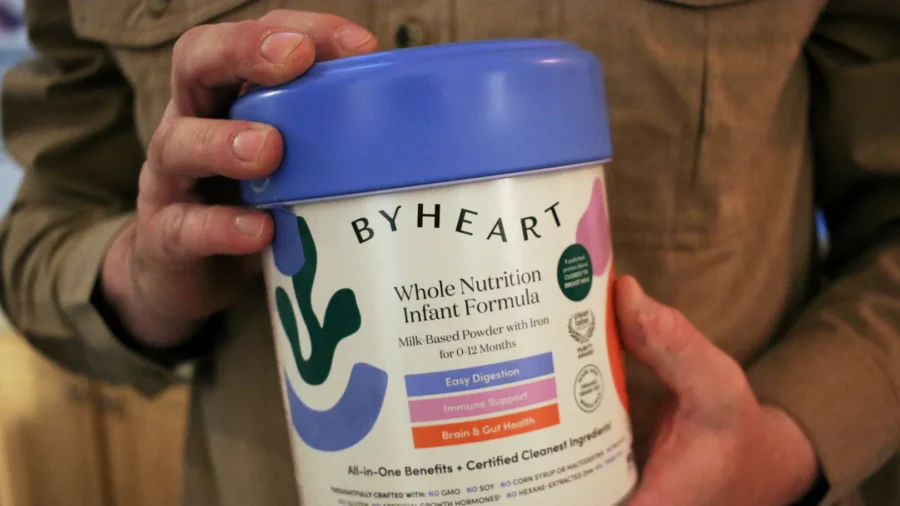
Federal health officials announced Wednesday that the number of babies sickened by contaminated ByHeart infant formula has nearly doubled in just five days, with 31 confirmed or suspected cases now reported across 15 states.
The outbreak, which began spreading in mid-August, has prompted an expanded nationwide recall of all ByHeart Whole Nutrition Infant Formula products.
The Food and Drug Administration said Wednesday that all 31 hospitalized infants had consumed the powdered formula before becoming sick. Despite the sharp increase in cases, no deaths have been reported.
On Nov. 8 California health officials confirmed the presence of Clostridium botulinum—a dangerous bacterium that produces the botulinum toxin—in an opened can of ByHeart formula that was fed to one of the affected babies.
The cases span from Arizona to Washington, with affected infants ranging in age from 16 to 200 days old. Infants became ill as early as Aug. 9, with the latest illness reported on Nov. 13. Among the infants with available age and sex information, roughly 46 percent are female.
ByHeart, a New York-based company that has operated since 2016, controls less than one percent of the nation's infant formula market. The company sells its products both online and through major retailers nationwide.
The FDA has received multiple reports that recalled formula remains on store shelves across several states despite the expanded recall announced on Nov. 11. Federal officials are coordinating with state partners and retailers to ensure all ByHeart products—including both formula cans and single-serve "anywhere pack" sticks—are removed from circulation.
"All ByHeart infant formula products have been recalled, and these products should not be available for sale in stores or online," the FDA said. The safety agency noted that any of the recalled products that were sold through online marketplaces and shipped internationally should not be used.
Parents and caregivers should immediately stop using any ByHeart infant formula and monitor their children for symptoms, authorities said.
According to the Centers for Disease Control and Prevention, infant botulism typically begins with constipation, poor feeding, loss of head control, and difficulty swallowing. These symptoms can progress to respiratory problems in severe cases, with illness potentially developing several weeks after formula consumption.
For children showing no current symptoms, continued monitoring is recommended, with medical attention sought if symptoms develop.
Anyone with leftover ByHeart formula should take a picture of the package and clearly mark the container with "DO NOT USE" in case state health officials need it for testing. If a child develops symptoms, parents should preserve the formula container to be potentially examined. After 30 days without symptoms, containers can be thrown away.
The only available treatment for infant botulism is BabyBIG, an intravenous medication made from blood plasma donated by adults vaccinated against botulism. Developed by California's Infant Botulism Treatment and Prevention Program—the sole worldwide source—each vial costs $69,300. All 31 infants affected by the current outbreak have received this treatment. Some severely affected babies may require ventilators to help them breathe.
ByHeart has faced previous quality concerns. The company issued a recall in 2022 after contamination was discovered at its packaging plant. In 2023, the FDA sent a warning letter to ByHeart citing areas requiring corrective actions.
The FDA has stressed that ByHeart's market share—less than one percent—means the outbreak does not create shortage concerns for baby formula.
The FDA investigation remains ongoing to determine where and how the contamination occurred. Officials note that detecting Clostridium botulinum in infant formula is difficult, and negative test results do not rule out the bacteria's presence.
Health Secretary Robert F. Kennedy Jr. has ordered the FDA to review infant formula ingredients as part of an initiative called "Operation Stork Speed," representing the first thorough examination of formula ingredients since 1998.
Parents and caregivers with concerns can contact the California Department of Public Health hotline at 1-833-398-2022, available daily from 7 a.m. to 11 p.m. PST. Physicians suspecting infant botulism can call 510-231-7600 for consultation, available 24/7.