


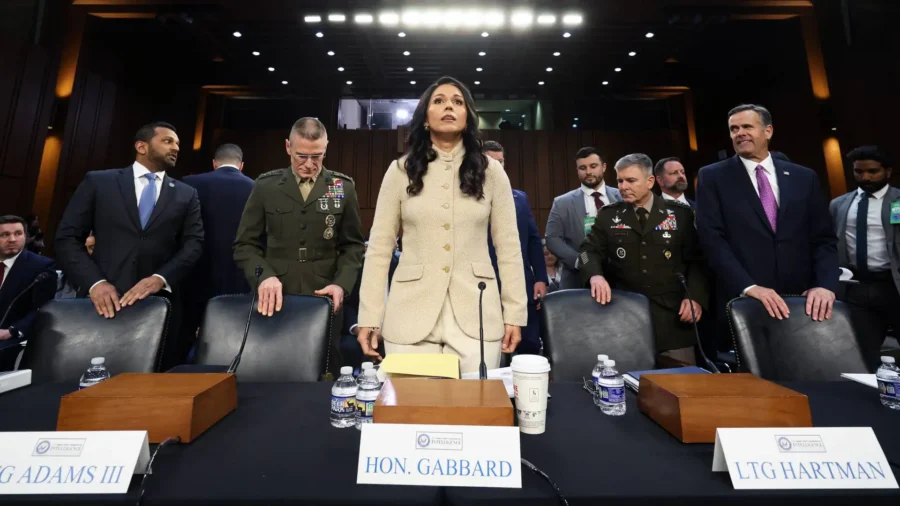
In her annual threat assessment remarks as DNI chair, Gabbard cited the spread of Islamist ideology, including that associated with the Muslim Brotherhood, as posing a threat to freedom and the foundation that underpins Western civilization.
“Islamist groups and individuals use this ideology for recruiting and financial support for terrorist groups and individuals around the world and to advance their political objectives of establishing an Islamist caliphate which governs based on Sharia,” Gabbard said.
Applied in the extreme, critics fear Islamic law, known as Sharia, can result in draconian punishments, such as stoning, flogging, or amputation.
Gabbard testified under oath on March 18 to SSCI chairs Sen. Mark Warner (D-Va.) and Sen. Tom Cotton (R‑Ark.).
"President Trump's designation of certain Muslim Brotherhood chapters as foreign terrorist organizations (FTOs) is a mechanism to secure Americans against this threat, in response to setbacks to their capabilities of conducting large‑scale, complex attacks," she said.
President Donald Trump announced Gabbard’s DNI nomination on Nov. 12, 2024, and the U.S. Senate confirmed her in February 2025. The former Democrat-turned-Republican advised the U.S. intelligence community to reassess Iran’s threat.
“The regime in Iran appears to be intact, but largely degraded due to attacks on its leadership and military capabilities,” she said. “Its conventional military power projection capabilities have largely been destroyed, leaving limited options.”
Trump pre-emptively struck Iran on Feb. 28, alongside Israeli Prime Minister Benjamin Netanyahu's Israeli Defense Forces.
Operation Epic Fury has sunk some 60 Iranian ships, struck more than 5,500 targets, leveled drone factories, neutralized 80 percent of Iran's missile launchers, and hit a large ballistic missile manufacturing facility.
U.S. nuclear deterrence has secured America as a whole, according to Gabbard, but there is a more global threat emerging.
“The intelligence community assesses that Russia, China, North Korea, Iran, and Pakistan have been researching and developing an array of advanced or traditional missile delivery systems with nuclear and conventional payloads that put our homeland within range,” she said.
Citing the rise of Artificial Intelligence while predicting that more than 16,000 missiles could threaten the U.S. homeland by 2035, Gabbard justified expanded U.S. efforts.
“AI has the potential to aid in weapons and systems design, and has been used in recent conflicts to influence targeting and streamline decision making, underscoring the risk and likely threats that could manifest on the battlefield,” she said.