


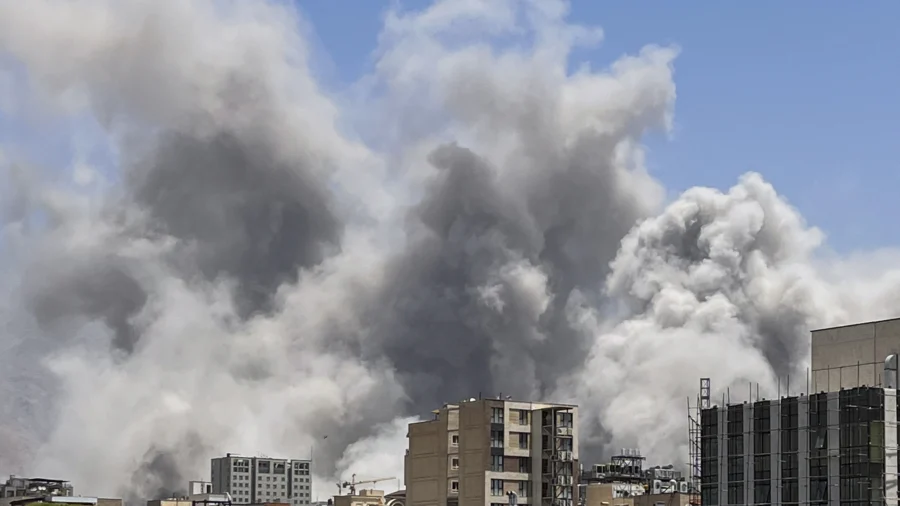
Iran’s Defense Minister Aziz Nasirzadeh has traveled to China, marking his first reported international trip since the onset of the war with Israel.
He will attend a meeting of defense ministers of Shanghai Cooperation Organization member states, which will be held on June 25 and 26 in the eastern city of Qingdao. The gathering will be hosted by Chinese Defense Minister Dong Jun.
He hoped China would continue to “uphold justice” and “play a greater role in maintaining the current cease-fire and easing regional tensions.”
The China-led regional security meeting also includes Defense Ministers Viktor Gennadievich Khrenin of Belarus, Khawaja Muhammad Asif of Pakistan, Baktybek Mukambetov of Kyrgyzstan, and Andrei Removich Belousov of Russia.
Beijing’s ties with Iran have deepened in recent years, making Iran a key partner in Chinese leader Xi Jinping's proposed Belt and Road Initiative.
On Sunday, the U.N. Security Council convened to discuss U.S. attacks on Iran’s nuclear sites. Russia, China, and Pakistan pushed for a resolution demanding an immediate, unconditional Middle East cease-fire.
Despite some displayed support for Iran, Beijing’s rhetoric has become more restrained, shifting from condemning Israel and U.S. military actions to advocating for dialogue and a cease-fire.
“[Let's] unite more like-minded progressive forces, uphold international fairness and justice, and maintain global strategic stability,” he said.
Wang urged both Israel and Iran to resolve differences “through dialogue to seek peaceful coexistence” and said China would “play a constructive role” in mediation.
On June 22, U.S. Secretary of State Marco Rubio urged China to dissuade Iran from closing the Strait of Hormuz, a vital global shipping route, in response to U.S. and Israeli strikes.
Chinese Foreign Ministry spokesperson Guo Jiakun avoided directly addressing Rubio’s request, stating China would “continue playing a constructive role for a deescalation.”
On Saturday, President Donald Trump announced that the U.S. had “completely and totally obliterated” Iran’s key nuclear facilities, marking the most significant Western military action against Iran since its 1979 revolution.