


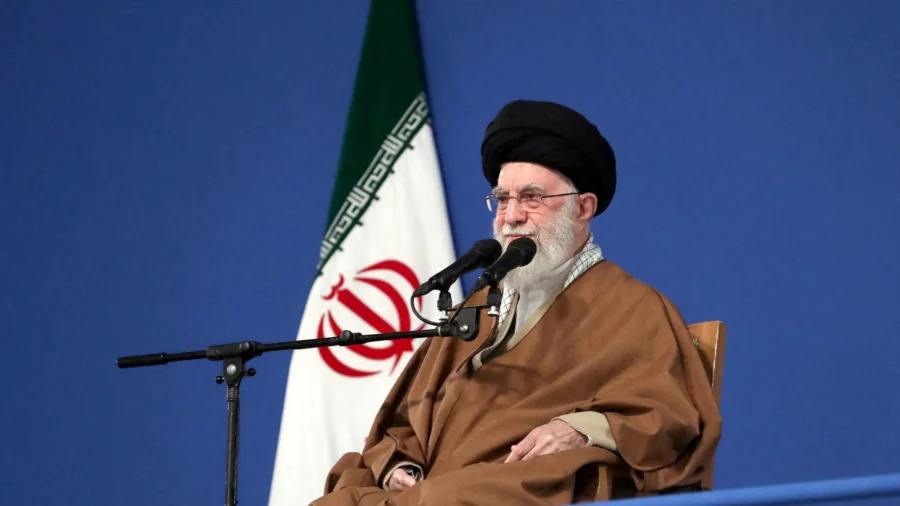
Iranian leader Ali Khamenei was killed in the U.S.-Israeli strikes, Iranian state media confirmed hours after President Donald Trump announced his death on social media.
"He was unable to avoid our Intelligence and Highly Sophisticated Tracking Systems and, working closely with Israel, there was not a thing he, or the other leaders that have been killed along with him, could do," Trump wrote in a post on his Truth Social platform on Feb. 28.
The U.S. president said this is "the single greatest chance for the Iranian people to take back their country."
Trump added that he has heard reports that Iranian military, security, and police forces "no longer want to fight, and are looking for Immunity from us."
"As I said last night, 'Now they can have Immunity, later they only get Death!,'" he posted. "Hopefully, the [Islamic Revolutionary Guard Corps] and Police will peacefully merge with the Iranian Patriots, and work together as a unit to bring back the Country to the Greatness it deserves."
The United States, he added, will continue “heavy and pinpoint bombing … uninterrupted throughout the week or, as long as necessary,” to achieve peace in the Middle East and the world.
Hours before Trump's announcement, senior Israeli security officials told Epoch Magazine in Israel that Khamenei was dead.
Israeli Prime Minister Benjamin Netanyahu said the United States and Israel’s joint strikes against Iran on Feb. 28 “destroyed the compound” of Khamenei.
"There are many signs that this tyrant is no longer,” Netanyahu said during a speech on Saturday.
"This is an opportunity to do something,” Netanyahu said.
“Do not sit with your arms crossed, because this moment will come and you will be demanded to go out of the streets in the masses, because you have to complete this work, and you have to bring down and eradicate this regime."
Trump did not suggest who he wanted to replace Khamenei.
"I don’t know, but at some point they’ll be calling me to ask who I’d like,” Trump said during the phone call.
“I'm only being a little sarcastic when I say that."
The commander of Iran’s Islamic Revolutionary Guard Corps, Iran’s defense minister, and the secretary of its Supreme National Security Council were killed on Saturday, according to an Israeli Defense Forces (IDF) spokesperson.
Minab Provincial Governor Mohammad Radmehr told the state-run IRNA that an all-girls school—located in Minab in the Hormozgan province—was hit in the strikes. The Epoch Times has not independently confirmed the claim.
Iran’s paramilitary Revolutionary Guard said in a statement that it had targeted American bases in the region including the U.S. 5th Fleet command in Bahrain, U.S. bases in Qatar and the United Arab Emirates (UAE), and military sites in Israel.
Saudi Arabia confirmed it had “successfully intercepted” Iran’s attack on its capital, Riyadh.
“These attacks cannot be justified under any pretext or in any way whatsoever, and they came despite the Iranian authorities’ knowledge that the Kingdom had affirmed it would not allow its airspace or territory to be used to target Iran,” the ministry added.
The meeting was scheduled after Russia, China, France, Bahrain, and Colombia requested an emergency meeting following U.S. and Israeli strikes on Iran on Feb. 28.
“I call for an immediate cessation of hostilities & de-escalation,” Guterres wrote in an X post.
“Failing to do so risks a wider regional conflict with grave consequences for civilians & regional stability. I strongly encourage all parties to return immediately to the negotiating table.”
“And the President decided he was not going to sit back and allow American forces in the region to absorb attacks from conventional missiles,” the official told reporters on a background call.
“We had analysis that basically told us, if we sat back and waited to get hit first, the amount of casualties and damage would be substantially higher,” the official said.