


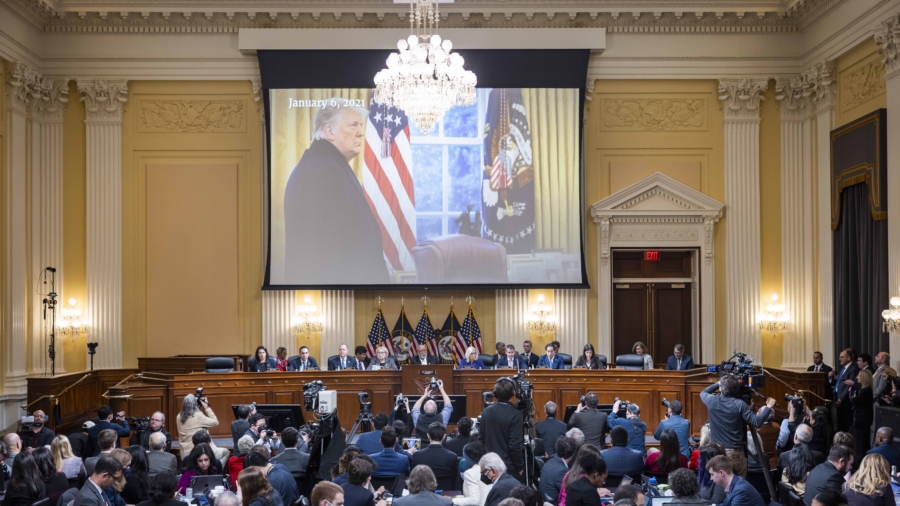
A U.S. House of Representatives panel on Dec. 19 voted to refer former President Donald Trump for criminal charges, including a charge that would, if a conviction is secured, bar him from becoming president again.
Members of the select committee to investigate the Jan. 6, 2021 breach of the U.S. Capitol cast the votes for four referrals during a hearing in Washington. They unanimously voted to refer insurrection, obstruction of an official proceeding, making a false statement to the federal government, and conspiracy to defraud the federal government to the U.S. Department of Justice, where prosecutors will ultimately determine whether to act on the recommendations.
"Accountability can only be found in the criminal justice system. We have every confidence that the work of this committee will help provide a roadmap to justice and that the agencies and the institutions responsible for ensuring justice under the law will use the information that we provided to aid in their work," said Rep. Bennie Thompson (D-Miss.), chairman of the panel.
A lawyer for Trump and the Department of Justice did not immediately respond to requests for comment.
One law bars obstruction of official proceedings, starting in part that a person may not "corruptly, or by threats or force, or by any threatening letter or communication influences, obstructs, or impedes or endeavors to influence, obstruct, or impede the due and proper administration of the law" by Congress.
A third statute forbids people from conspiring to defraud the United States. The code was defined by a Supreme Court justice as "primarily to cheat the Government out of property or money, but it also means to interfere with or obstruct one of its lawful governmental functions by deceit, craft or trickery, or at least by means that are dishonest."
Another law bars making a false statement to the federal government.
If the Department of Justice follows through with the recommended charges, Trump would face up to 25 years in prison and fines.
Trump was charged with incitement of an insurrection by the U.S. House of Representatives with regard to the Jan. 6, 2021 breach of the U.S. Capitol, but the Senate acquitted Trump in an impeachment trial.
Special counsel Jack Smith, recently appointed by Attorney General Merrick Garland, is heading two investigations that do or could involve Trump. That includes the probe into whether Trump violated laws by holding certain records at his Mar-a-Lago resort, and the investigation into crimes linked to the interference of the transfer of power following the 2020 presidential election or the electoral vote certification held on Jan. 6.
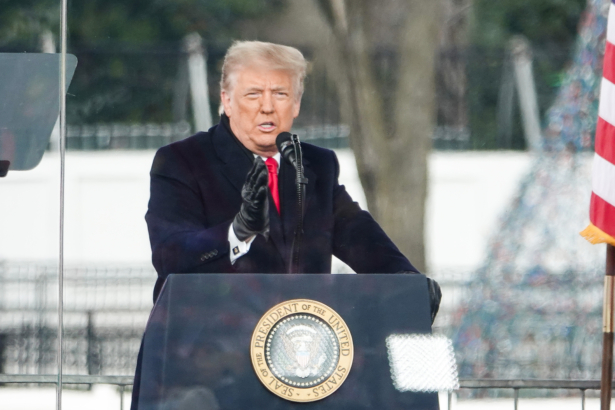
Trump, in a speech on The Ellipse on Jan. 6, urged supporters to "fight like hell" and to go to the Capitol, but he also called on people to "peacefully and patriotically make your voices heard."
Not one person has been charged with insurrection in connection with the breach. A subset of those charged have been convicted of or are facing seditious conspiracy charges.
The House Jan. 6 panel is dominated by Democrats. Only two Republicans are on the panel, and both were appointed by House Speaker Nancy Pelosi (D-Calif.). House Republican Leader Kevin McCarthy (R-Calif.) proposed a slate of members, but Pelosi rejected two of them, prompting McCarthy to pull the rest.
Rep. Adam Schiff (D-Calif.), a member of the panel and the chairman of the House Intelligence Committee, signaled Sunday that the panel would refer Trump for charges.
Schiff said that "if you look at Donald Trump's acts, and you match them up against the statute, it's a pretty good match," adding: "I realize that statute hasn't been used in a long time. But, then, when have we had a president essentially incite an attack on his own government?"