



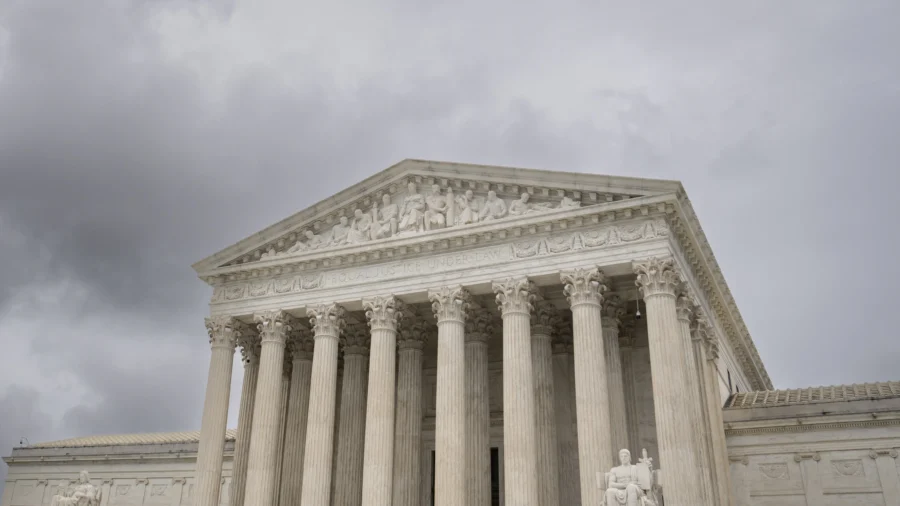
The Supreme Court issued a series of decisions on June 25 with far-reaching impact on President Donald Trump’s immigration policies, the Second Amendment, and agribusiness Monsanto.
Trump’s immigration enforcement agenda got a boost as the Supreme Court ruled lower courts were barred from reviewing his decisions to remove deportation protections for certain nationals. In another case, the Supreme Court gave Trump and future presidents greater flexibility in restricting asylum seekers’ attempts to cross the border.
Hawaii’s gun control policy also lost in court, as the justices said the law violated the Second Amendment. The decision continued the court’s emphasis on comparing gun control policies to historical laws in deciding these cases.
Finally, Monsanto won some legal protection against future lawsuits over its weedkiller and allegations that it caused cancer.
Court Greenlights Trump’s Removal of Deportation Protections
During his second term, Trump removed deportation protections—also known as Temporary Protected Status—for nationals from countries across the world. Under this program, immigrants are permitted to stay in the United States for humanitarian reasons, such as conflicts and natural disasters.The decisions in Mullin v. Doe and Trump v. Miot greenlit the Trump administration’s removal of temporary protected status for Haitians and Syrians. It also likely paves the way for ending the protections for other nationalities.
However, Justice Samuel Alito’s majority opinion left some room for judges to scrutinize and potentially reject removals of temporary protected status. Judges could rule on arguments over whether the revocations violated the Constitution, Alito said.
Hawaii’s Gun Restrictions Violated Second Amendment
The court ruled 6–3 that a Hawaii law restricting residents from carrying concealed weapons in stores and hotels violates the Constitution.The law barred handguns from privately owned public places, such as gas stations and shopping malls, without the owner's permission.
Justice Samuel Alito said the state law could not stand because the Second Amendment “has the same meaning in all parts of the United States.”
The Hawaii law “hobbles what the Second Amendment protects,” inconveniencing lawful gun owners by forcing them “to avoid all the territory where the possession of a gun is prohibited outright, but they may also be barred from entering many places that people routinely visit in the course of their daily routines.”
Monsanto Shielded From Liability in Weedkiller Lawsuits
The Supreme Court, in Monsanto v. Durnell, issued a decision that’s expected to help the agribusiness avoid liability in future complaints about its signature weedkiller Roundup.A Missouri man named John Durnell had sued, alleging that the company failed to warn about purported cancer risks from exposure to glyphosate, an ingredient in Roundup.
Writing for the majority, Justice Brett Kavanaugh said Durnell’s case rested on the idea that states could go beyond warning requirements already imposed by the federal government. He pointed to how the EPA had repeatedly declined to require additional warnings for glyphosate.
Authorities Can Turn Away Asylum Seekers at the Border
In Mullin v. Al Otro Lado, the Supreme Court said federal law allowed immigration enforcement to turn away asylum seekers at the border.Its decision was based on the Immigration and Nationality Act, which provides that a migrant who “arrives in the United States” may apply for asylum. Another section states that migrants who arrive should be inspected by an immigration officer, who is expected to refer them for asylum if they intend to apply.
In its June 25 decision, the court clarified that a migrant arrived only if they crossed the border. “An alien standing in Mexico does not ‘arrive in the United States’ by attempting, and failing, to set foot in this country,” Justice Samuel Alito said in the court’s majority opinion.