


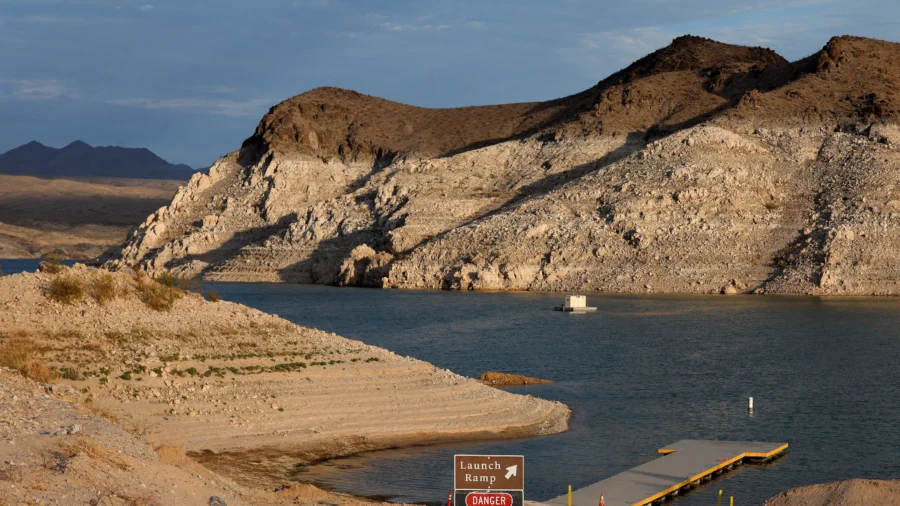
Lake Mead, the largest reservoir in the United States, sank to a record-low water level on Thursday.
The reservoir's pool elevation measured 1,040.50 feet at 4 a.m. MST on Thursday, edging past the previous record of 1,040.58 feet set in July 2022, according to data published by the U.S. Bureau of Reclamation. The lake, formed by Hoover Dam on the Colorado River, straddles the Nevada-Arizona border and has been losing elevation daily since July 31.
Officials have tracked the lake's elevation since the reservoir began filling in the 1930s, and Thursday's reading marked the lowest level in that entire record.
A System Under Strain
Lake Mead and the broader Colorado River Basin supply water to as many as 40 million people and provide hydropower across seven states—Arizona, California, Colorado, Nevada, New Mexico, Utah, and Wyoming—according to the bureau. The reservoir also delivers carbon-free hydroelectric power generated at Hoover Dam.Prolonged drought and exceptionally thin mountain snowpack this year have driven the declines across several Colorado River Basin reservoirs. The bureau warned earlier this year that record-low snowpack could push both Lake Mead and Lake Powell toward critical thresholds.
Lake Powell, the nation's second-largest reservoir, stood at 3,521.43 feet as of Thursday—closing in on its own record low of 3,519.92 feet set in April 2023. That level is significant because it approaches the elevation required for the Utah-Arizona reservoir to keep generating hydropower, and projections show a new record low there could arrive as soon as this month.
A Long-Term Decline
The lake's slide has unfolded over decades. Bureau of Reclamation records show Lake Mead peaked at 1,225 feet above sea level in July 1983, and by November 2024 the reservoir was reported to be just 33 percent full, according to the Lake Mead Earth Resources Observation and Science (EROS) Center. Landsat satellite imagery dating to 1972 has documented the shrinking waterline over that span.The lake's steep, canyon-bound setting has partly masked the scale of the loss, since a large drop in elevation does not translate into as dramatic a reduction in surface area as it would in a shallower basin. Even so, the shrinking shoreline remains visible.
The Colorado River supplies not only Las Vegas but also Phoenix, Los Angeles, and San Diego, and demand keeps climbing as those cities grow. At the same time, diminished mountain snowpack has reduced the river's flow, leaving less water to replenish the reservoir.