


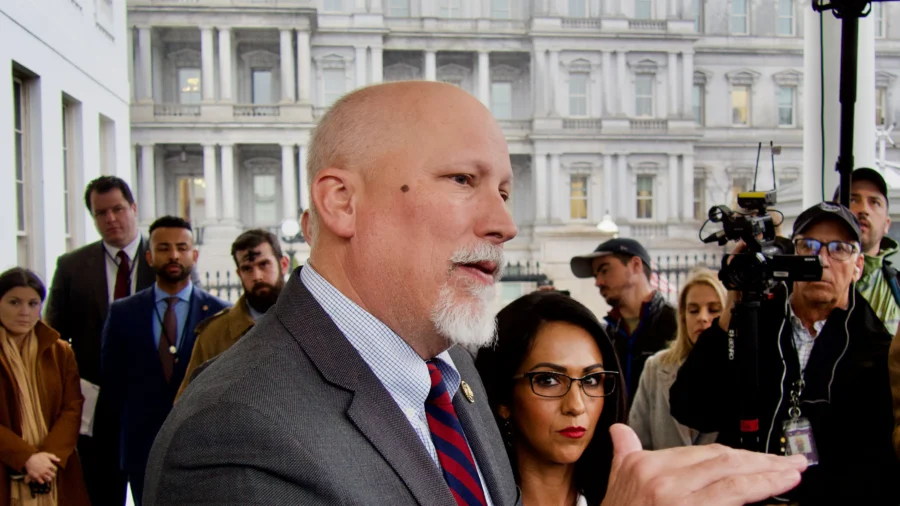
Rep. Chip Roy (R-Texas) is raising concerns with the Trump administration about an Islamic infrastructure project planned near Camp Bullis, a military training base in San Antonio, Texas.
The project has “potential national security implications” given that it’s being constructed near “a critical military installation” that provides training for armed services branches, Roy wrote in an Aug. 26 letter sent to Attorney General Todd Blanche, Secretary of War Peter Hegseth, and Secretary of the Treasury Scott Bessent.
The Northside Islamic Center of San Antonio (NICSA) is nearing completion of the 7.25-acre multipurpose community campus—located within roughly 18 miles of Camp Bullis—to expand its influence in the region, Roy said, citing an Aug. 14 report by the activist group RAIR Foundation USA.
The campus is expected to have a mosque, educational institutions, businesses, housing, and separate sharia-compliant prayer areas for women, men, and children.
Islamic leaders of the NICSA have “partnered with the Muslim Brotherhood, an organization with a history of collaborating with extremist groups and receiving foreign terrorist designations for several of its chapters, to raise funds for the NICSA expansion project near Camp Bullis, suggesting these entities are a part of a possible terror network,” Roy said.
In November last year, President Donald Trump issued an executive order to set in motion a process by which certain Muslim Brotherhood chapters would be considered for designation as Foreign Terrorist Organizations and Specially Designated Global Terrorists.
Camp Bullis is a U.S. Army training camp spread across more than 27,000 acres in Bexar County and provides base operations support and training support to Joint Base San Antonio. It is primarily used as a maneuvering ground for combat units from the Army, Air Force, and the Marines. Camp Bullis also provides training facilities for the Texas National Guard personnel.
In his letter, Roy raised concerns about comments by a religious leader involved in the NICSA expansion, its main imam AbdulRahman Kattan. On the NICSA website, the imam is named AbdulRahman Kattab.
“NICSA’s project also raises concerns given its plans to make Sharia-compliant sections of its development,” Roy said. “Sharia (Islamic law) subjugates women, children, and non-Muslims to second-class citizenship while sanctioning varying forms of punishment for those opposed. Under no circumstances should Sharia, or any foreign legal code, be practiced on U.S. soil, including community developments.”
Sharia law is Islamic law governing ritual practices and interpersonal conduct of Muslims.
In his letter, Roy called efforts to spread sharia law and any Islamic code in the United States a “direct contravention” of the U.S. Constitution.
The lawmaker called for a review of NICSA’s efforts to establish a community center near Camp Bullis, assessing the project for any financial, criminal, civil, or immigration violations.
The Epoch Times reached out to NICSA for comment but did not receive a response by publication time.
According to a NICSA brochure about the project, the new mosque will feature a 33,000-square-foot, two-story building with prayer rooms and other amenities. The residential development program is expected to increase attendance at the mosque and provide stable income for its operations.
NICSA said part of its vision is to educate Muslims and non-Muslims of the “proper Islamic theology and methodology which serve as the bulwark against terrorism, extremism, and antipathy.”
In February, the Department of Housing and Urban Development said it would investigate entities in the project due to concerns that the initiative may have engaged in discrimination based on religion and nationality.
In an Aug. 26 podcast with political commentator Glenn Beck, Trump affirmed his administration’s stance regarding sharia law in the United States.
“I would absolutely prohibit the sharia law thing, and it is happening in this country a little bit. And where we see it, we take it out. And you have to take it out. You have one system. We have a great system. Sometimes it's very frustrating, but it's the best there is that I can see,” Trump said.