


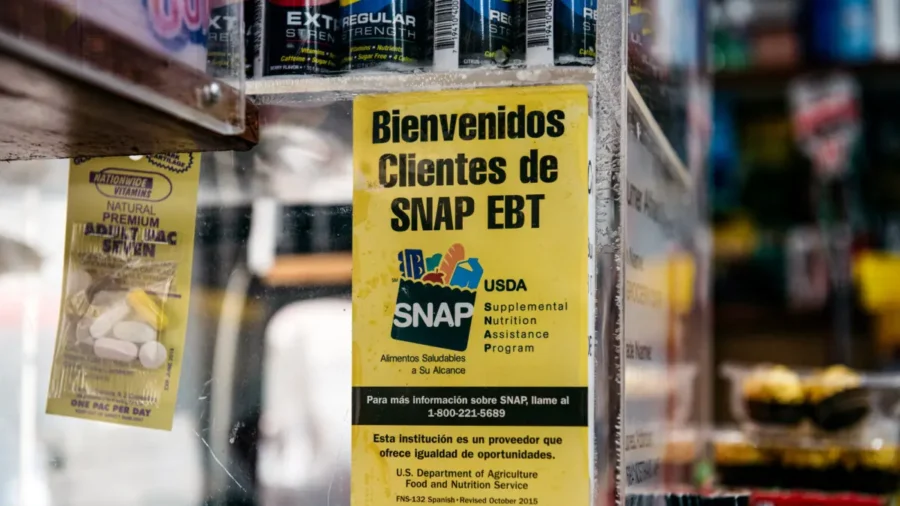
Millions of Americans are days away from a potential food crisis, as a weeks-long federal government shutdown brings the Supplemental Nutrition Assistance Program (SNAP) to a halt for the first time in decades. The funding shortage leaves about 42 million people bracing for the loss of monthly grocery aid, according to the U.S. Department of Agriculture (USDA).
The USDA announced Friday that it will not issue SNAP benefits for November, warning, “At this time, there will be no benefits issued November 1,” according to the department.
For the federal fiscal year 2024, there were 451,200 residents who received assistance from the program in New Mexico, which amounts to 1 in 5 people. More than 61 percent of recipients in the state are in families with children, while 31 percent are in families with members who are disabled or older adults. Nationally, figures are nearly the same, amounting to 62 percent and 37 percent for the same tallies.
Washington, D.C., trails close behind at 20 percent, with Louisiana and Oregon each at 18 percent, and Oklahoma at 17 percent. Massachusetts, Illinois, Michigan, Nevada, and Pennsylvania round out the top 10, each with about 15 to 16 percent of their populations relying on SNAP. At least 5 percent of every state, plus the District of Columbia, used the program in fiscal 2024.
"The economic impact on our local business community will be severe as hundreds of SNAP retailers, including many that operate in food deserts, will lose a vital revenue stream," Schwalb said in the announcement. "If these stores are forced to close, even non-SNAP recipients will lose access to critical sources of food.”
Louisiana officials have said that SNAP benefits will not be issued to recipients starting Nov. 1 in their state, according to the Louisiana Department of Health. The state currently serves 792,769 residents in 396,157 households through the program.
But the safety net is now in jeopardy, threatening a population that includes 16 million children, 8 million seniors, and 4 million people with disabilities, according to figures from the research policy think tank.
State governors from both parties are bracing for a surge in demand at food banks, and large states—such as California—have called in the National Guard to help distribute food and keep shelves stocked.
Martina McCallop of Washington shared the difficult choices many face: “I have to pay my bills, my rent, and get stuff my kids need,” she said. “After that, I don’t have money for food.”
Volunteers at Central Christian Church’s pantry in Indianapolis tracked double the normal daily volume over the weekend, as the reality set in. “There’s an increased demand. And we know it’s been happening really since the economy has downturned,” Beth White, a volunteer, explained. “It’s going to continue to get worse for folks.”
However, even some such moves could face limits. The USDA has told states that those covering SNAP costs temporarily will not be reimbursed—a reality that restricts options for cash-strapped governments. Arkansas, among others, is directing residents to seek help from food pantries, charities, friends, and family.
While some states have managed temporary fixes—Connecticut will use reserve funds to operate WIC through the shutdown, and Nevada secured $7.3 million to keep benefits available into December—many states say their programs remain day-to-day, with warnings of instability if the shutdown drags on.
“When you take SNAP away, the implications are cataclysmic. ... It’s already too bad. And it’s getting worse,” Feeding America CEO Claire Babineaux-Fontenot said in a recent interview.
Food pantries and banks, which provide about one meal for every nine delivered by SNAP, have reported alarming inventory shortages as the shutdown’s consequences trickle through the supply chain, according to Feeding America.