


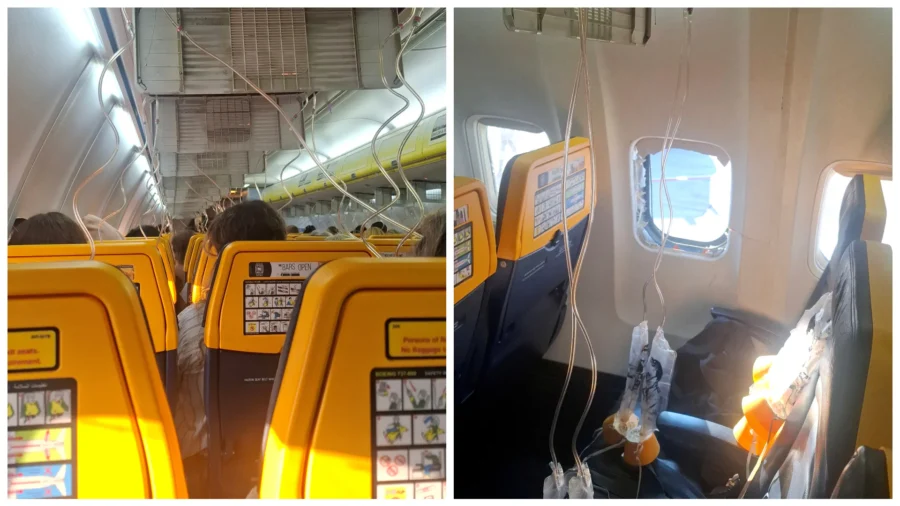
A passenger on a flight from northern Greece to Germany was partially pulled through a broken airplane window and then dragged back inside by fellow travelers shortly after takeoff Friday.
The Malta Air flight, operating on behalf of Ryanair, had departed from Thessaloniki and was headed to Memmingen, near Munich, when the window failure occurred a few minutes into the journey.
The airline said in a statement that the plane returned to Thessaloniki soon after takeoff after “a passenger window dislodged in-flight.”
Details of the injured passenger were not immediately disclosed.
Several passengers told Greek media they heard a loud bang before oxygen masks dropped and the aircraft began losing altitude.
One traveler, identified only as Christina, said some people panicked and screamed as a passenger was partly sucked out of the opening. “His whole head, neck, shoulders” were pulled out of the window, she said, adding that nearby passengers managed to pull him back inside. She described the noise as similar to “a tire bursting … but very loud” and said, “We knew straight away we lost pressure because we lost altitude.”
Ryanair has not said what caused the window to come loose.
The U.S. National Transportation Safety Board said it was informed that the plane turned back due to “a right engine issue and cabin decompression” and that it is ready to assist. Under international rules, the Aircraft Accident and Incident Investigation Committee of the Republic of North Macedonia will lead the inquiry because the incident happened in that country’s airspace.
The North Macedonian agency did not immediately respond to an email from NTD News seeking comment.
Short video clips shared with Radio Thessaloniki showed passengers wearing oxygen masks after the cabin lost pressure. Another video appeared to show the missing window, with a man seated nearby wearing an oxygen mask, and a third clip, filmed after landing, showed first responders working in the aisle.
Shye Gilad, a former airline pilot who now teaches at Georgetown University’s business school, said the episode highlights the need to keep seatbelts fastened while seated. He said a sudden decompression can briefly create strong suction near a breach before the pressure stabilizes and that “the seatbelt can help in those first few seconds,” calling such incidents “very rare” because “it takes a lot to breach a cabin.”
The aircraft involved was a Boeing 737-800 delivered new to Ryanair in 2008, according to flight-tracking site Flightradar24.
Flight data showed the jet climbed past 15,000 feet about six minutes after departure, then descended to around 6,000 feet to burn fuel for 30 minutes before returning to Thessaloniki roughly an hour after takeoff.
Ryanair said the plane landed normally, passengers returned to the terminal, one person received medical help on the ground, and a replacement plane later took travelers on to Germany.