


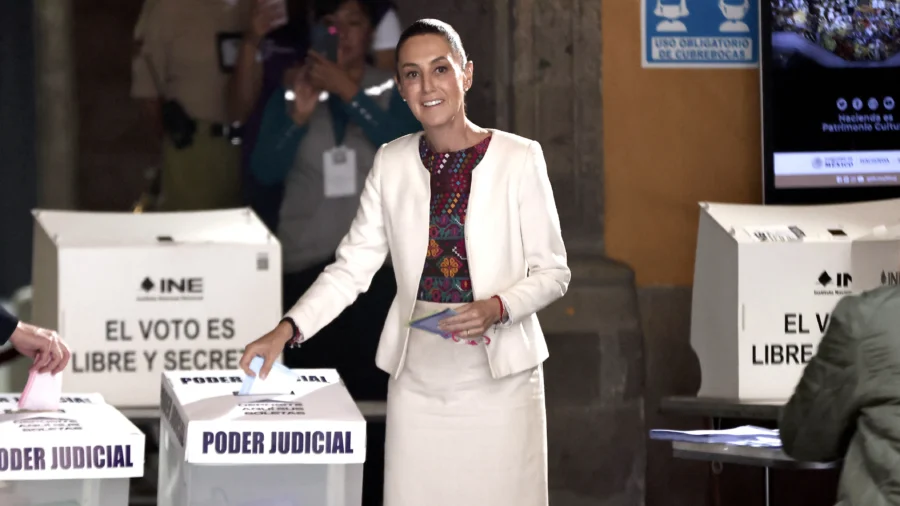
Mexicans are voting on June 1 in the country's first-ever judicial election. The outcome will determine the composition of the country's court system, from the lowest level magistrate courts up to the Supreme Court.
In all, the country is set to remake its judiciary branch in two rounds of voting.
According to Mexico's National Electoral Institute, more than 4,000 candidates will compete on Sunday for approximately 900 seats at all levels of Mexico's federal judicial court system, including all nine positions on Mexico's Supreme Court.
Thousands more candidates will compete for 1,800 local judicial seats across 19 of Mexico's 31 states.
Mexico will hold a second round of elections in 2027 to cover the rest of the country's judicial seats in the remaining 12 states and in the federal district of Mexico City.
Until last fall, Mexico had relied on an appointment system, whereby the country's federal judicial council filled vacancies based on criteria that considered merit and experience.
The country's first-ever attempt at a fully democratic vote to decide its judiciary system has met with both excitement and consternation.
In August 2024, then-U.S. Ambassador to Mexico Ken Salazar issued a statement cautioning Mexico's congress over the types of reforms they were considering.
Former Mexican President Andrés Manuel López Obrador, who frequently clashed with Mexican judges, has been a proponent of the changes.
In September 2024, Mexico's congress approved a series of reforms. In addition to moving to a popular vote for selecting judges, the reforms reduced the number of Supreme Court seats from 11 to nine, halved the necessary work experience to five years, and did away with a requirement for judge candidates to be at least 35 years old.
Obrador's party, the left-wing populist Morena Party, championed these reforms. President Claudia Sheinbaum, who is López Obrador's successor and a fellow Morena Party member, has also cheered the proposed changes to the judicial system.
Critics of the reforms have warned the changes will politicize the judiciary, with judges refraining from challenging the edicts of the country's ruling party.
Francisca Pou Giménez, a senior researcher at the National Autonomous University of Mexico, said the reforms send Mexico down the same path as Venezuela, where "the judiciary was subordinated at the beginning by Chavismo, with profound, long-lasting damage to democracy, up to this day.”
During a panel discussion at the Wilson Center in Washington in September 2024, Mexican circuit judge María Amparo Hernández Chong Cuy said she believes the reform process was rushed, and the results worrisome.
Turning the judge selection process into a popular vote has also fueled concerns about the types of candidates who could soon fill seats in the courts.
“What I can promise you is I’ll be an impartial judge,” she told voters during a recent campaign stop in Ciudad Juarez, a city that sits across the border from El Paso, Texas.
The election rules prohibit political parties from endorsing, criticizing, advertising for, or otherwise attempting to financially support judge candidates. The candidates must instead self-finance their campaigns, and face constraints with when and how they may promote their campaigns.
Candidates cannot purchase advertising time on television and radio stations. They also cannot pay for online advertisements, but can spread their campaign messaging on social networks.
Opponents of the judicial election process have urged their fellow citizens to boycott the vote.