


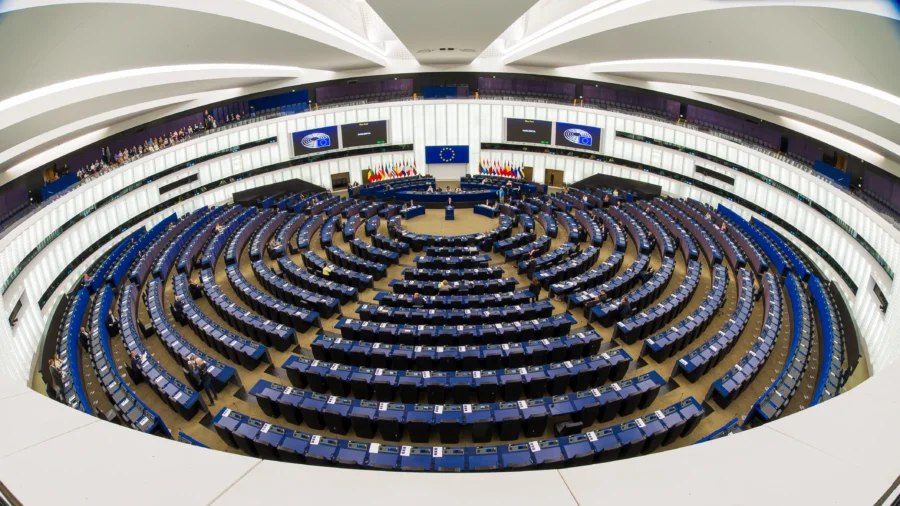
Members of the European Parliament voted on Thursday for an EU law allowing tech platforms to scan unencrypted private messages and emails for child sexual abuse material.
The July 9 vote concerned a law dubbed “Chat Control 1.0,” a temporary exception to EU privacy rules that normally protect the confidentiality of private messages and emails.
The legislation allows messaging and webmail providers to scan private messages, emails, and chats for child sexual abuse material (CSAM).
A motion to reject the European Council position received more votes in favor than against, 314 to 276, with 17 abstentions, but failed because it did not reach the required absolute majority of MEPs. As a result, the second reading was closed, and the amended Parliament position will now go to the Council.
European Commission (EC) President Ursula von der Leyen—a prominent member of the European People's Party (EPP), the largest political group in the European Parliament—pushed the measure.
EPP vice chair Tomas Tobé said in a July 9 post on X that his party “fought hard to protect children from sexual abuse online and we will never stop doing so.”
“EP has adopted a second reading, and we need to close the legal gap. It is now up to the Council to finalize it, and EPP urge the Council to do so for our Children, for Europe," he said.
The measure has also been backed by major tech companies.
In a March joint statement, Google, LinkedIn, Microsoft, Snapchat, TikTok, and Meta urged EU lawmakers to “swiftly agree on a way forward for voluntary CSAM detection in interpersonal communication services.”
It said that it uses hash matching, a technique that uses "irreversible digital fingerprinting" to identify illegal material.
"Chat Control 1.0" is voluntary, not mandatory for now.
Surveillance Concerns
Critics warned that the new law risks normalizing mass scanning of digital communications across Europe."This is not about catching criminals. It is mass surveillance imposed on all 450 million citizens of the European Union," the group stated.
“Trying to protect children with suspicionless mass surveillance is like frantically mopping the floor while the faucet is still running,” he said. “Blanket chat control is just as unacceptable as indiscriminately opening everyone’s physical mail.”
“We need more child protection, not less—but we need effective protection, not the illusion of security,” he said.
Breyer and other critics said the proposal was pushed through via an urgent procedure, a mechanism they say is meant for new legislative proposals rather than those Parliament has already rejected.
He said that the vote showed the measure was advancing despite opposition from most voting lawmakers.
“The fact that Chat Control is moving forward against the will of the majority of voting MEPs is a farce and damages democracy. Our children are the real losers in this undemocratic process,” Breyer said.
“The passage of a genuine, permanent child protection regulation is now in serious jeopardy. The Council will never agree to a desperately needed paradigm shift as long as they can simply stick to the old approach of suspicionless scanning at the whim of the tech industry,” he said.
“Thanks to the approval of our amendment to protect—at least for now—the encryption of personal conversations, the law will not come into force immediately and must be validated by the Council,” Vox’s European Parliament delegation said in a July 9 post on X.
"But there is nothing to celebrate; an attack has been committed against freedoms," it stated.
"This is not democracy. If a vote does not please her or her political group, she cannot simply decide to hold the vote again and again until it passes,” the group said.
The Epoch Times contacted Roberta Metsola for a response.