
Moolenaar Introduces Bipartisan Bill to Ban Chinese Land Purchases Near US Sensitive Sites

Under the proposed legislation, any land purchase by a foreign adversary near a sensitive U.S. site is a national security threat.
Published: 5/9/2026, 1:37:01 PM EDT
Moolenaar Introduces Bipartisan Bill to Ban Chinese Land Purchases Near US Sensitive Sites
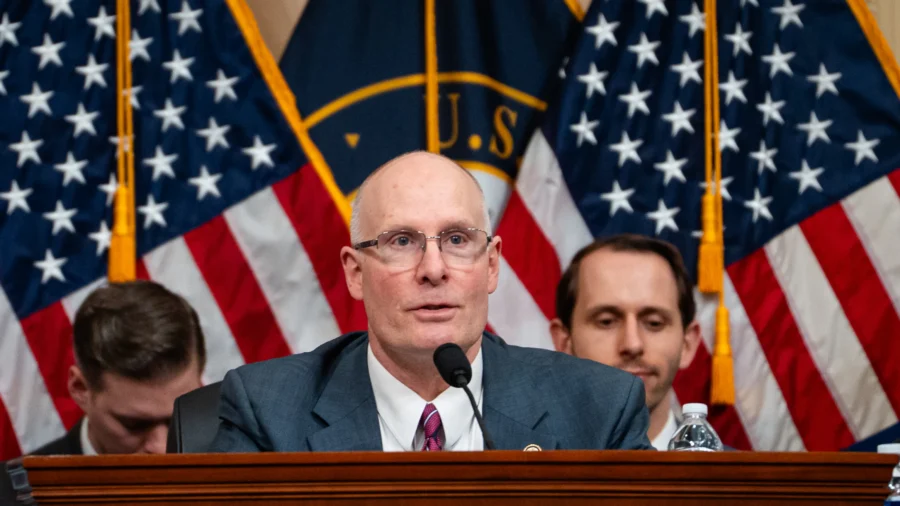
Chairman of the House Select Committee on the Chinese Communist Party, Rep. John Moolenaar (R-Mich.), presides over a hearing in Washington on March 5, 2025. (Madalina Vasiliu/The Epoch Times)

Rep. John Moolenaar (R-Mich.) introduced a bipartisan bill on May 7 to transform how the federal government scrutinizes foreign land acquisitions, moving from a system of passive disclosure to one of active prevention.

"The Protecting U.S. Farmland and Sensitive Sites from Foreign Adversaries Act" seeks to secure American agricultural and technological interests by closing the legal gaps that currently allow adversarial entities to gain geographic proximity to critical infrastructure.

At the heart of the bill, the "Presumption of Unresolvability" clause stipulates that any land transaction involving a foreign adversary near a sensitive site is a threat that cannot be mitigated. This shift forces the Committee on Foreign Investment in the United States, or CFIUS, to prove that a transaction is safe by "clear and convincing evidence" before it can proceed—a rigorous hurdle that prioritizes national security over private foreign investment, according to the bill.

“Food security is national security, and we cannot allow foreign adversaries like China to buy up American farmland near our most sensitive military and critical infrastructure sites,” said Moolenaar, chairman of the House Select Committee on the Chinese Communist Party.

A Targeted National Security Priority

While the legislation designates a broad list of foreign adversaries—including Russia, Iran, North Korea, Cuba, and Venezuela—China is the primary driver of the initiative. This focus is supported by the distinctive scale and strategic clustering of Chinese-linked acquisitions compared with those of other designated nations.
As of December 2023, U.S. Department of Agriculture data show that Chinese primary investors reported owning 277,336 acres of U.S. agricultural land, whereas holdings from other adversaries, such as Iran (3,030 acres), Cuba (58 acres), and Russia (11 acres), remain significantly smaller.

"The Chinese Communist Party's brazen efforts to collect intelligence on American soil demonstrate its intention to exploit any and all gaps it can find in our national security architecture," said Alexandria Paolozzi Moore, senior director of government relations at FDD Action, as cited in Moolenaar's May 7 press release.

Security experts, including those from the America First Policy Institute (AFPI), say that the strategic nature of these acquisitions allows the CCP to establish a potential platform for surveillance and sabotage, and unlike transient agents, these land holdings provide a legal and persistent base of operations.

Safeguarding Agricultural Sovereignty, Critical Infrastructure

The legislation addresses two primary pillars of national strength: agricultural sovereignty and infrastructure exposure. By expanding the definition of national security to include agricultural biotechnology and long-term domestic needs for food and water, the bill ensures these critical resources are protected from adversarial interference or sabotage.

Furthermore, the legislation establishes a new "Elevated Risk" category for real estate near sensitive sites, now officially encompassing maritime ports, Federal Aviation Administration-listed airports, and critical telecommunications infrastructure, including data centers and fiber-optic nodes.

Recent federal filings involving Offutt Air Force Base in Nebraska highlighted the importance of security protections, as a Chinese national was charged with illegally photographing sensitive aircraft. Liang Tianrui was arrested on April 7 at JFK International Airport in New York while attempting to leave the United States after a judge in Nebraska issued a warrant four days earlier.
Although individual trespassers can be prosecuted under statutes such as 18 U.S.C. 795, current law does not prevent an adversary from owning a private, legal site just outside a base fence line to conduct similar surveillance.

Integrating Federal and State Authority

The bill includes a "Preservation of State Authority" clause, ensuring that federal oversight does not override those states that have already passed their own restrictions. States like Florida, Arkansas, and Texas have pioneered these efforts by prohibiting foreign principals from adversary nations from owning land; Moolenaar’s bill would provide a federal baseline to ensure that no state remains a soft entry point for adversarial influence.