


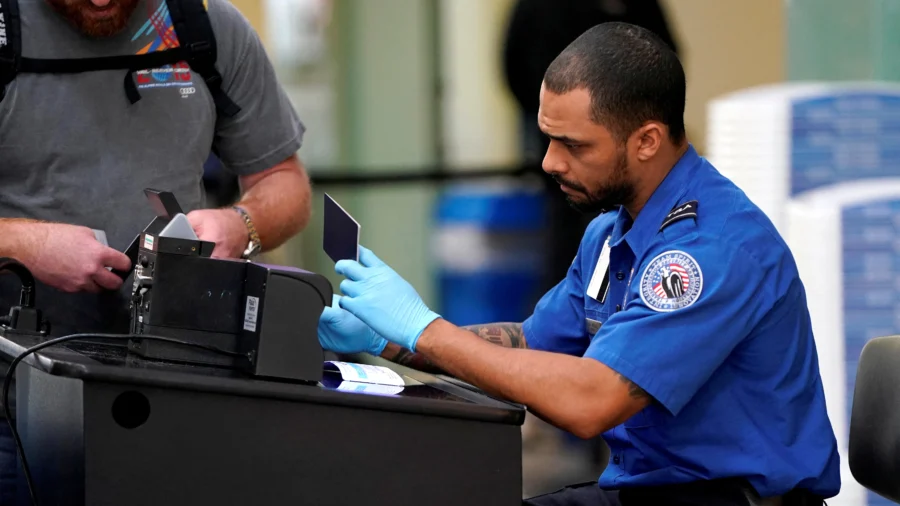
The Department of Homeland Security (DHS) said Monday that more than 1,000 Transportation Security Administration (TSA) officers have left the agency since the partial shutdown began on Feb. 14.
The department announced the drastic drop in staffing in a post on X, blaming Democrats in Congress for the prolonged shutdown.
“This loss has SIGNIFICANTLY decreased TSA’s ability to meet passenger demand and left critical gaps in staffing, as each new recruit requires 4-6 MONTHS of training,” DHS wrote.
Fliers at airports across the United States experienced hours-long security lines earlier in the spending lapse.
“[The American public is] going through a big struggle right now, and we just put ICE in charge, and they’re helping TSA—the agents—and they’re working together so far very well,” Trump said at the time.
“As Democrats continue to put the safety, reliability, and efficiency of our air travel system at risk, [President] Donald Trump is taking decisive action—deploying hundreds of ICE officers, already funded by Congress, to the airports under the greatest strain,” Bis said.
“At this point, we have to look at all options on the table. We don’t have the luxury of picking and choosing how we maintain our operations,” McNeill told lawmakers.
“And that does require us to, at some point, make very difficult choices as to which airports we might try to keep open and which ones we might have to shut down as our callout rates increase.”
More than 50,000 TSA employees had been working without pay for weeks.
But there’s still no long-term plan from Congress to fully fund DHS.
Republicans and Democrats are blaming each other for the spending standstill. An array of funding proposals have come from both sides, but none have successfully advanced.
GOP lawmakers are criticizing their counterparts for not passing their proposals, as Democrats demand a guaranteed overhaul of immigration operations in exchange for a funding agreement.
On March 27, the House passed a stopgap plan to fund DHS for 60 days. The bill was sent to the Senate, which had already left for a two-week recess.
“My payroll at DHS is just over $1.6 billion every two weeks,” Mullin said. “There is no more emergency fund, so the president can’t do another executive order for us to use money, because there’s no more money there.”
If brought up by the House, the resolution would allow congressional committees to write detailed legislation on allocation of the funds, which would then require Trump’s signature to take effect.
Trump praised the Senate’s effort and urged Republicans to unify to achieve full funding for DHS.