

THE HAGUE, Netherlands—On the final day of the NATO summit, members on Wednesday endorsed a defense spending target of 5 percent of GDP by 2035.
All NATO members will be expected to spend 3.5 percent of their GDP on core defense, such as troops, weapons, and equipment.
They will also be expected to earmark a further 1.5 percent of GDP for defense and security-related infrastructure, such as adapting roads, bridges, and ports for use by the military, cyber-proofing assets, and protecting energy pipelines and undersea cables.
NATO Secretary-General Mark Rutte said the new target will “fuel a quantum leap in our collective defense.”
“They agreed to boost our defense industries, which will not only increase our security, but will also create jobs. And we have reaffirmed our unwavering support for Ukraine. All of this is crucial,” Rutte said.
“It means that no matter the challenges we face better from Russia or terrorism, cyber attacks, sabotage or strategic competition, this alliance is and will remain ready, willing and able, to defend every inch of allied territory and ensure that our 1 billion people can continue to live in freedom and security.”
During a meeting of the North Atlantic Council on Wednesday, Rutte told Trump, who sat next to him, “Your leadership made this possible.”
Earlier, Rutte said, “For too long, one ally, the United States, carried too much of the burden of that commitment, and that changes today.”
German Chancellor Friedrich Merz said the “decisions we make are not to do anyone a favor” but because allies agree that “the threat situation has changed, and the threat is Russia in particular.”
The communiqué agreed by the 32 NATO members on Wednesday reads, “United in the face of profound security threats and challenges, in particular the long- term threat posed by Russia to Euro-Atlantic security and the persistent threat of terrorism, Allies commit to invest 5 percent of GDP annually on core defence requirements as well as defence-and security-related spending by 2035.”
Rutte and several other world leaders described the agreement as historic.
The communiqué specified that all NATO members would earmark, “1.5 percent of GDP annually to … protect our critical infrastructure, defend our networks, ensure our civil preparedness and resilience, unleash innovation, and strengthen our defence industrial base.”
Trump: ‘Problem With Spain’
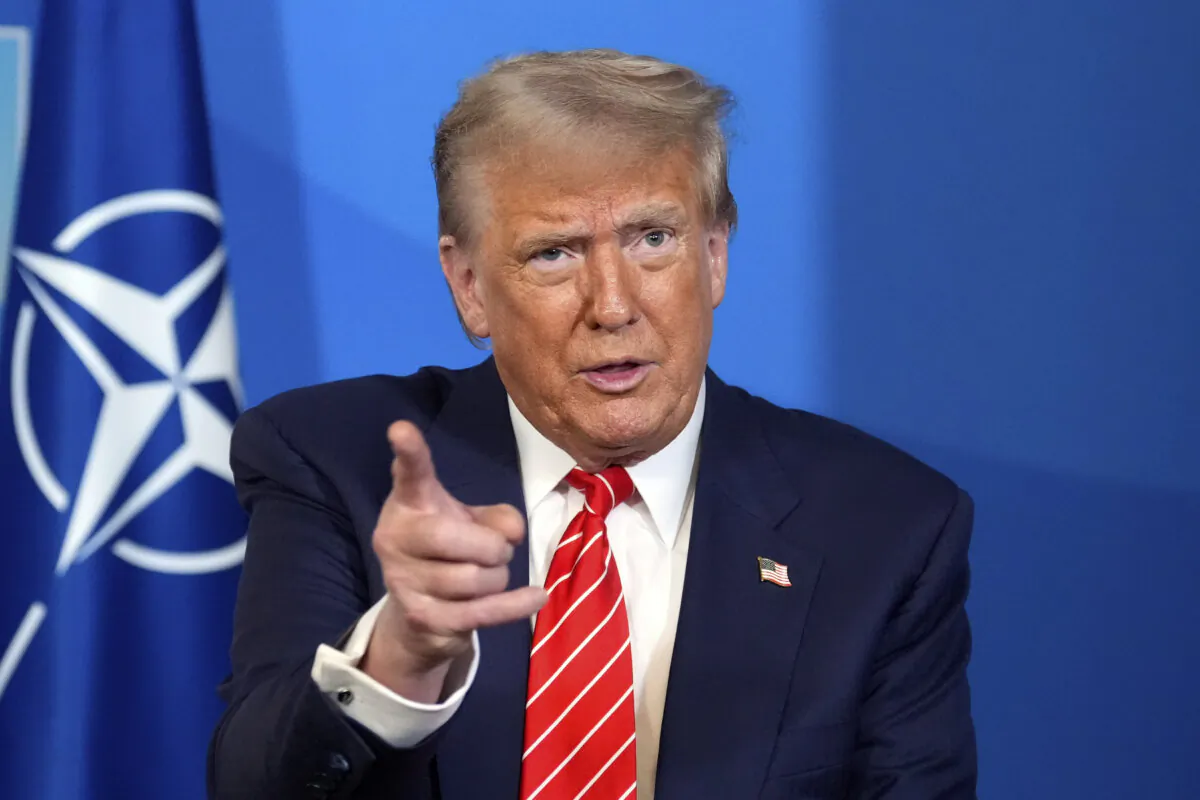
On June 24, U.S. President Donald Trump said, “There’s a problem with Spain. Spain is not agreeing, which is very unfair to the rest of the people.”Another item on the agenda was Ukraine.
That promise was omitted from this year’s end-of-summit communiqué which said, “Allies reaffirm their enduring sovereign commitments to provide support to Ukraine, whose security contributes to ours.”
On Wednesday, Trump said he would meet Ukrainian President Volodymyr Zelenskyy at the summit and said, “We’ll discuss the obvious. We’ll discuss his difficulties.”
On Wednesday, Hungary’s Prime Minister Viktor Orban said, “Russia is not strong enough to represent a real threat to us. We are far stronger.”
NATO was founded in 1949 in the wake of the Soviet Union’s blockade of Berlin, which forced Washington to airlift food and other necessities into the besieged German capital at the start of the Cold War.
The United States, Britain, and the Netherlands were among the 12 founder members, and since the collapse of the Soviet Union and the fall of communism, 14 countries in Eastern Europe have joined.
‘Prepare For War’
On Tuesday, Rutte told a defense industry forum meeting at the summit, “There is an ancient Roman saying, ‘If you want peace, prepare for war’.”Kremlin spokesman Dmitry Peskov said on Tuesday, “[NATO] is an alliance created for confrontation … It is not an instrument of peace and stability … [it] is confidently moving along the path of rampant militarisation.”
Peskov said that to justify the extra spending, “you need to draw a picture of a fiend of hell, a monster. And the point of view of these NATO functionaries, our country is the one best suited for the role of the monster”