


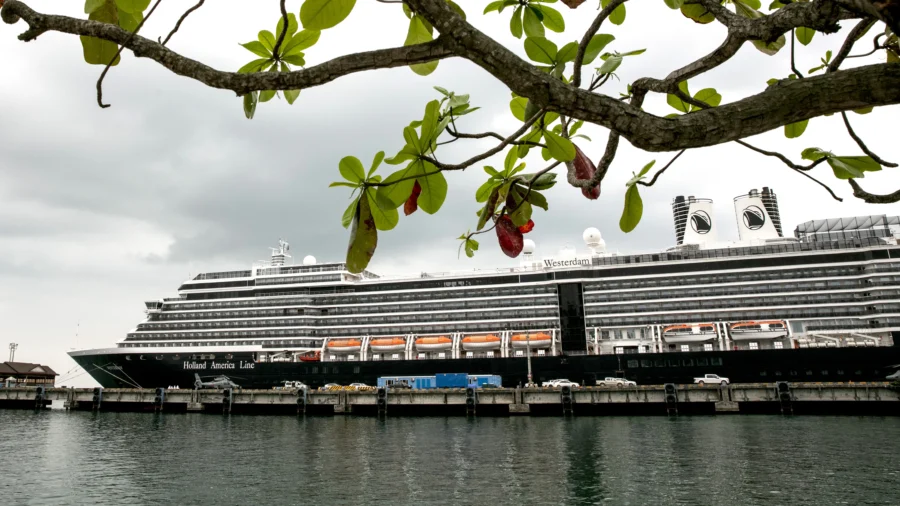
Nearly 80 cruise passengers and crew members fell ill in a suspected norovirus outbreak aboard Holland America Line’s MS Westerdam during an Asian cruise, according to Hong Kong health authorities and the cruise line.
Holland America confirmed the incident in an email to media outlets, saying "the cases were mostly mild and quickly resolving." The company said it implemented "enhanced sanitation procedures and conducted additional deep cleaning" once the ship docked in Hong Kong.
A spokesperson for the cruise line did not return a request for comment from NTD News prior to publication.
The MS Westerdam, operated by Holland America Line, docked at 4 a.m. Sunday with about 2,000 passengers and 800 crew members on board, according to the Centre for Health Protection (CHP) of Hong Kong's Department of Health. Investigators from the CHP's Port Health Division, Epidemiology Division, and Infection Control Branch boarded the ship to inspect sanitation and food hygiene conditions. A temporary clinic was also established at the terminal to evaluate passengers as they exited.
Dr. Edwin Tsui, controller of the CHP, said authorities were alerted late on Feb. 27 by the cruise operator about possible infections en route to Hong Kong. “Given the current high activity levels of norovirus in some tourist destinations, particularly in neighbouring regions like Japan and Korea where activity has been rising since late last year, I urge cross-border cruise passengers and operators to pay special attention to personal, food, and environmental hygiene to safeguard individual health and public health,” Dr. Tsui said in the government release.
Health officials determined that 76 people—38 men and 38 women ranging in age from 24 to 92—suffered acute gastroenteritis since Feb. 15. That total included 65 passengers and 11 crew members. Most experienced vomiting, diarrhea, or mild fever. The first cases were reported in Japan shortly after passengers boarded. The ship's route also included stops in South Korea's Busan and mainland China's Shanghai.
Some vomit was found in public areas on board, raising concerns of wider spread. The ship's physician said most passengers recovered quickly and did not need hospital care. When the ship arrived in Hong Kong, just three passengers were reported experiencing mild symptoms. Laboratory testing of seven stool samples showed traces of norovirus, according to the CHP, which said further analysis was underway.
All travelers cleared to enter Hong Kong were screened for potential infection and advised to seek medical attention if symptoms developed. After sanitation checks were completed, the Westerdam set sail again that night bound for the Philippines, with Hong Kong health officials notifying their Philippine counterparts of the case findings.
The clinic notes that norovirus is extremely contagious, spreading through close contact with infected individuals, contaminated surfaces, or food and drinks handled by someone who is sick. Even a few viral particles can cause infection. Symptoms typically appear within 12 to 48 hours and last one to three days.
There is no specific treatment for the virus, most people recover on their own with rest and staying hydrated. The virus on the other hand can remain contagious for up to 48 hours after symptoms stop and linger in the body for up to two weeks.
Because the Westerdam’s voyage did not stop at any U.S. ports, it fell outside the jurisdiction of the CDC’s Vessel Sanitation Program, which monitors illnesses on international cruise itineraries that include U.S. destinations.
The CDC previously reported that cruise ship outbreaks of gastrointestinal illness—most often caused by norovirus—increased in 2025 compared with prior years, with Holland America accounting for several cases.
Health authorities, including the CDC and Hong Kong officials, advise travelers to wash their hands frequently with soap and water, avoid handling food when ill, and report any gastrointestinal symptoms immediately to onboard medical personnel. Hand sanitizer alone does not effectively kill norovirus particles, according to the Cleveland Clinic.