


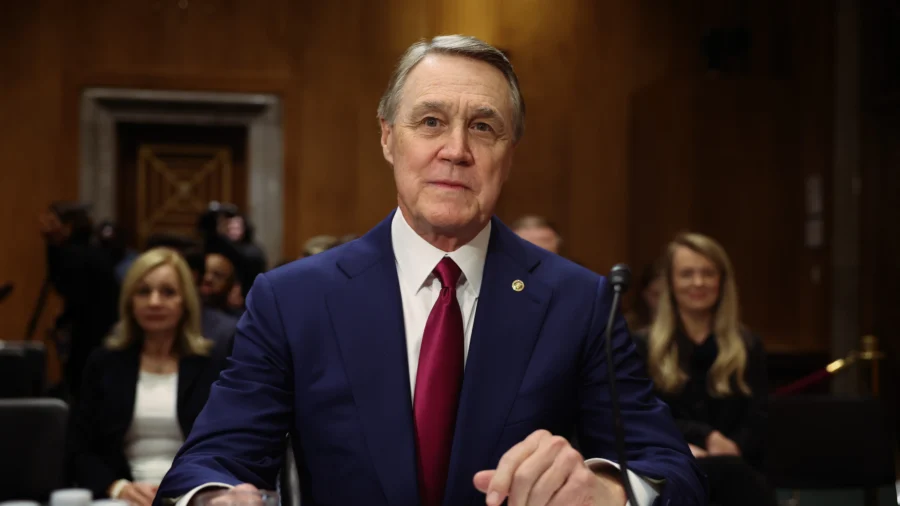
Amidst turbulent relations between the United States and China, the new U.S. envoy to China, Ambassador David Perdue, arrived in Beijing on Thursday.
The 75-year-old Republican, a former business executive turned China hawk, signalled his readiness to tackle the diplomatic challenges ahead.
The Chinese Foreign Ministry responded, saying that China was ready to “provide convenience” for Perdue to perform his duties in the country.
Hardened Stance on China
Once a champion of global trade, Perdue has mirrored Washington’s bipartisan hawkish shift toward Beijing, its top geopolitical rival. He told a forum in Washington in 2018 that he didn’t like tariffs, but believed Trump’s “instincts are right.”At the same forum in Washington, he expressed disillusionment with earlier hopes that China’s economic growth would lead to greater democratization. “We all got it wrong. We thought as China became more affluent ... that they would open up and liberalize,” he said. “That just hasn’t happened.”
Perdue’s rhetoric on China has hardened in recent years. Last year, he accused Beijing of seeking to “destroy capitalism and democracy” and advocated for the United States to decouple its supply chains from China. He also warned of U.S. complacency in the face of Beijing’s growing aggression as its global influence expands.
However, during his confirmation hearing last month, Perdue struck a more measured tone, calling for a “nuanced, nonpartisan, and strategic” approach to Beijing.
Lowest Bilateral Relations in Decades
Perdue’s arrival comes at a critical juncture, as U.S.-China relations have sunk to their lowest point in decades.He replaces career diplomat Nicholas Burns, a Biden appointee who departed in January. Earlier this year, Burns issued an order prohibiting U.S. government personnel in China, along with their family members and contractors holding security clearances, from engaging in romantic or sexual relationships with Chinese citizens.
Beyond trade—where challenges include achieving equal market access, addressing forced technology transfers, intellectual property theft, compliance with global trade norms, and cyber warfare—he is tasked with addressing opioid fentanyl, territorial disputes, and human rights concerns.
One of Perdue’s main objectives is to persuade Beijing to halt the export of precursor chemicals used to manufacture fentanyl, a deadly opioid responsible for a significant portion of U.S. drug overdoses. These precursors are linked to 20 percent of the remaining U.S. tariffs on China.
Tensions also persist over the South China Sea, where China claims nearly the entire region—a claim the U.S. rejects—as Washington remains a staunch supporter of Taiwan, the self-governing island democracy that Beijing considers its own territory but has never ruled.
Additionally, China’s support for Russia following its 2022 invasion of Ukraine, including purchasing Russian oil and gas and supplying electronics for Russian drones, has further strained relations with the United States.
The United States has been vocal in its criticism of China’s human rights record, particularly regarding the repression of civil liberties in Tibet, Xinjiang, and Hong Kong, as well as persecution of the Falun Gong spiritual movement.
Perdue was raised in Warner Robins, Georgia, in a farming community. He studied at the Georgia Institute of Technology before working as an executive in firms ranging from clothing to logistics.
He served as a U.S. senator from Georgia from 2015 to 2021, chairing the Senate Armed Forces Committee’s Sea Power Subcommittee in 2019, and ran for Georgia governor in 2022. During his Senate tenure, Perdue focused on military and security issues and visited Taiwan in 2018 to meet then-President Tsai Ing-wen.