


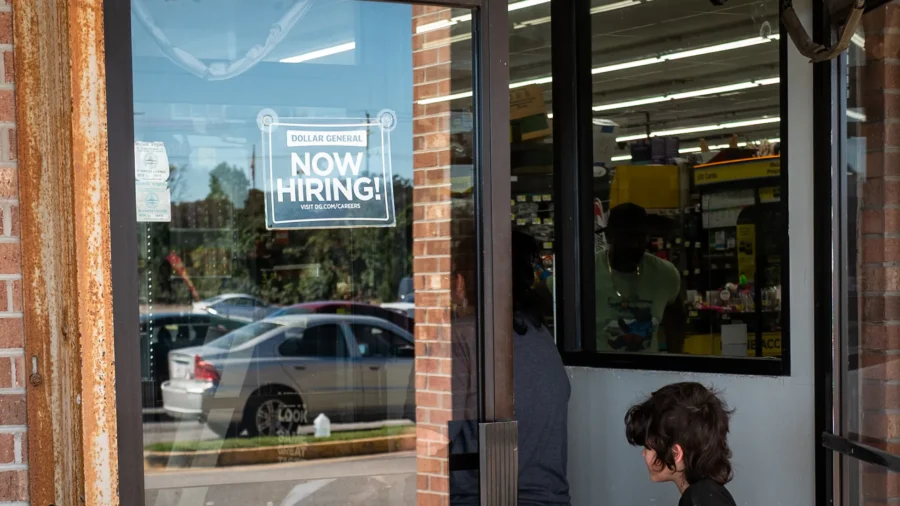
The number of Americans currently receiving unemployment benefits declined to a two-year low, sending mixed signals about employment conditions across the U.S. economy.
For the week ending March 14, continuing jobless claims fell to 1.819 million from the previous week's downwardly revised 1.851 million, according to new Department of Labor data released on March 26.
This represented the lowest reading since January 2024 and came in below economists' expectations of 1.85 million.
Economic observers pay attention to recurring claims because they can serve as a proxy for the difficulty of employment conditions for unemployed individuals.
It can also signal that Americans' jobless benefits have been exhausted since many states cap eligibility at 26 weeks.
Since the start of the year, various indicators have been illustrating different developments in the labor market, from payroll growth to job vacancies.
"You had these tiny pockets with some labor market jitters, the jolts [Job Openings and Labor Turnover Survey] numbers weren't very good, and we had a jobs report that wasn't very good. But underlying everything, the fundamentals were good," Cullen Rogers, portfolio manager and chief investment officer at Wedbush Fund Advisers, said in a note emailed to The Epoch Times.
But tensions in the Middle East may have started clouding the outlook—at least temporarily—and have presented investors with an “interesting paradox,” according to Rogers.
"I think at this point, assuming that this is a shorter-term geopolitical event, the fundamentals are still strong," Rogers stated.
A chorus of Federal Reserve officials remains worried about the labor market’s health.
“Of course, I’ve written three cuts in before the end of 2026 to hopefully support the labor market,” Bowman said.
While odds of a rate hike later this year have diminished, monetary policymakers are still concerned about inflation staying above the central bank’s 2 percent target.
Fed Governor Christopher Waller, in a March 20 interview with CNBC’s “Squawk Box,” reaffirmed the balancing act between supporting the labor market and combating inflation.
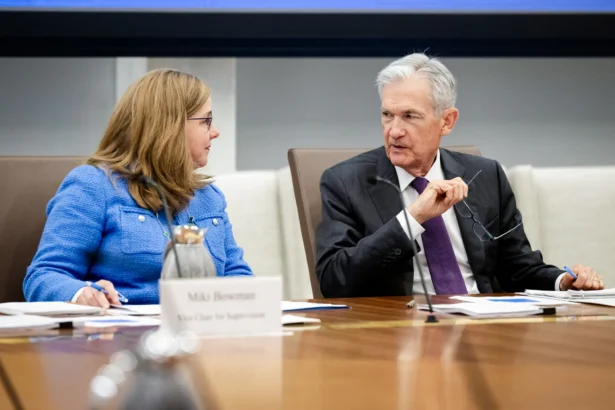
“If we get another 90,000 jobs decline in the next jobs report, that’ll be like four negative reports out of five. To me, that’s not zero. So at that point, you need to start thinking about this labor market isn’t good,” Waller said.
“I don’t think this war is going to help in any way going forward, but we’ll have to see what happens with inflation.”
Unemployment Filings
New claims for unemployment benefits ticked up last week but remain at historically low levels.Initial jobless claims rose by 5,000 to 210,000 for the week ending March 21, according to the Department of Labor. This was in line with the consensus forecast.
The four-week average, which strips out week-to-week volatility, dipped to 210,500—the lowest level since late January.
At the same time, labor demand has been anemic. Indeed’s job openings have been declining throughout March and are lingering at a four-month low.
The current "low fire, low hire" often described in this climate is weighing on U.S. workers.
A new Gallup survey found that 49 percent of employees are "struggling," and 46 percent are "thriving." Additionally, 72 percent of workers believe it is presently a "bad time" to find a quality job.
"In a tighter market, those corrections can be stalled. When workers cannot, or believe they cannot, leave, discontent can accumulate inside organizations rather than being corrected with turnover," the polling firm said in a March 24 report. "This can create a quieter but more persistent drag on productivity, morale and culture."
The number of job quits—employees voluntarily leaving their positions—has been steadily declining over the past few years, reaching 3.1 million in January, according to the Bureau of Labor Statistics.
Economists watch this metric because it can reveal workers' confidence about the current state of the labor market.
Put together with immigration reforms and trade policy, today’s labor market can have a “feel of downside risk,” says Fed Chair Jerome Powell.