


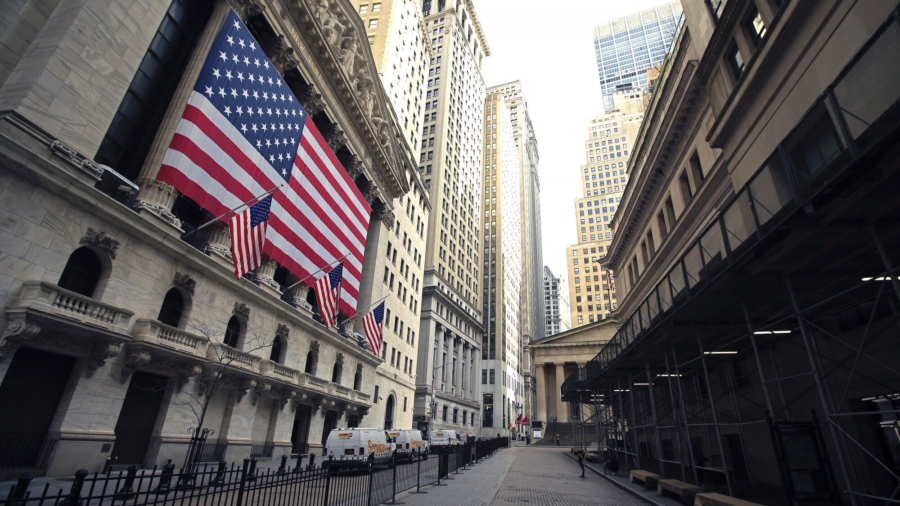
Growing distrust of the Chinese regime over how it handled the virus outbreak should prompt Wall Street to rethink its dealings with China, says hedge fund manager Kyle Bass.
Financial Decoupling?
As the pandemic continues to exact mammoth human and economic costs worldwide, a growing number of countries and regions are reevaluating their ties with the communist regime.With the CCP virus causing particular devastation across northeastern U.S. states—with New York and New Jersey ranking as the two worst-hit regions in America—residents, institutions, and governments in those regions should be attuned to the fact that the virus’s global spread stemmed from the regime’s cover-up of the outbreak, said U.S.-based China commentator Heng He.
“Had the Chinese Communist Party not lied, and rather truthfully reported the outbreak situation … then perhaps it could have been contained within China,” Heng told NTD, an affiliate of The Epoch Times.
However, it remains to be seen if U.S. financial institutions will start disengaging with the regime as a result of the crisis.
“Wall Street has always been really cooperative with China, fueling the Chinese economy,” Frank Xie, an associate professor in the School of Business Administration at the University of South Carolina, told The Epoch Times.
Piece of the Market
Prior to this, even though the regime had not fulfilled its pledge to open up its banking sector upon joining the World Trade Organization (WTO) in 2001, foreign banks “have nonetheless worked hard to grab a piece of the Chinese market,” Xie said.He noted that Wall Street banks have helped many Chinese companies list on U.S. stock exchanges. As of Sept. 2019, there were 172 Chinese firms listed on major U.S. exchanges with a market capitalization of more than $1 trillion, according to the United States-China Economic and Security Review Commission.
Instances of fraudulent accounting at Chinese firms, with U.S.-listed Luckin Coffee being the latest high-profile scandal, has not deterred investment firms either, Xie said.
“I think they know a lot of [Chinese] companies are fraudulent, that a lot of companies are not abiding by financial rules, reporting rules, and accounting rules,” he said. “But unless there are companies like Muddy Waters that reveal their wrongdoings, they’ll continue to invest.”
In early April, shares in Luckin Coffee collapsed after the Chinese beverage brand said an internal investigation found that its chief operating officer had falsified 2019 sales by about $310 million. In January, short seller Muddy Waters Research said it would bet against the stock, based on a report that the company was committing fraud.
Blinded
Bass blasted U.S. financial firms and companies for ignoring China’s human rights abuses in pursuit of the Chinese market.“And yet people like Blackstone can't wait to invest another dollar in China,” Bass continued.
US Action
The first step towards remedying this situation would be to make Chinese companies listed on U.S. stock exchanges open their audit books to U.S. regulators, Bass said. Currently, the regime blocks the SEC (Securities and Exchange Commission) or U.S. regulators to examine audit work papers of Chinese companies, saying they contain “state secrets.”“Any company that wants to list in the United States—forget about if it's just from China or from anywhere else in the world—you have to adhere to real audits just like U.S. companies do, you have to adhere to the same standards as U.S.-listed companies,” he said.
“Let's just level the playing field—that's not being punitive.”
U.S. public pension funds have also come under intensifying scrutiny over its investments into Chinese companies, including those that support the regime’s military, espionage, and human rights abuses.
In recent years, global stock index providers such as MSCI and FTSE have added Chinese stocks to their global and emerging markets indices, allowing billions of dollars of U.S. investment to flow into Chinese equities.
Among the companies included in the MSCI index is Chinese surveillance equipment manufacturer Hangzhou Hikvision Digital Technology, which was placed on a U.S. trade blacklist last year because its technology was being used for repression of Uyghur Muslims in China’s western Xinjiang region.
The index also includes Hong Kong-listed AviChina Industry & Technology Ltd., the listing company for Chinese state-owned firm Aviation Industry Corporation of China (AVIC). AVIC and its subsidiaries develop aircrafts and weapons systems for the Chinese military.