


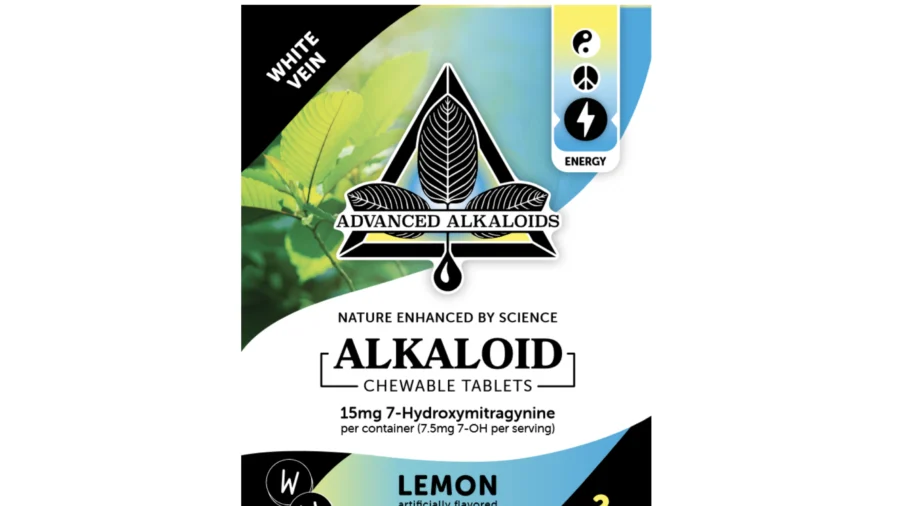
Shaman Botanicals has issued a nationwide recall of certain “Alkaloids” chewable kratom tablets after tests found higher-than-labeled levels of a powerful opioid-like compound, according to the U.S. Food and Drug Administration.
The voluntary recall covers one lot of Advanced Alkaloids brand Alkaloids Chewable Tablets—White Vein (Lot B# AAW.501.3)—which contain the kratom-derived chemical 7-hydroxymitragynine, or 7-OH, in greater amounts than the listed 7.5 milligrams per tablet.
The affected products were sold nationwide to wholesalers, retailers, and directly to consumers online in three package sizes: a 2-count bag (UPC 810057763724), a 20-count bag (UPC 810057763830), and a 30-count bottle (UPC 810057763779), according to a Feb. 17 FDA notice. The lot number appears on the package and on the bottom of the bottle, and all expiration dates in Lot B# AAW.501.3 are included in the recall.
Shaman Botanicals said it has not received any reports of illnesses tied to the recalled lot but urged wholesalers, retailers, and consumers to stop using it and return it for a refund or replacement. Customers are being notified by email and directed to register returns through an online recall portal. Consumers with questions can contact the company’s quality department in North Kansas City, Mo., by phone or email, and are advised to reach out to a health care provider if they experience problems after using the tablets, according to the recall.
At the same time, the product carries prominent health and safety warnings acknowledging that its psychoactive alkaloids act on all known opioid receptors and “may be habit-forming,” with regular usage potentially leading to dependence, addiction, and withdrawal.
Federal Warning on 7-OH dangers
The recall comes amid escalating alarm from federal regulators over high-potency 7-OH products sold as tablets, gummies, drink mixes, and shots in gas stations, smoke shops and online, the FDA said in a consumer update issued in July 2025. The agency describes 7-OH products as “novel potent opioid products” that “have not been proven safe or effective for any use and should be avoided,” and notes that 7-OH is not lawful as a dietary supplement or food ingredient because it fails to meet safety standards.While 7-OH occurs naturally in trace amounts in kratom leaves, regulators are targeting items where 7-OH has been added or concentrated to “dangerous” levels. The agency has received reports of addiction, anxiety, depression, gastrointestinal problems, insomnia, seizures and withdrawal symptoms—including restlessness, body aches, fatigue, irritability, and cold sweats—in connection with 7-OH products.
Texas Officials Track Rising Illnesses
State health officials in Texas have also sounded the alarm as exposures surge. Last summer, the Texas Poison Center Network logged 192 reports involving kratom or products containing 7-OH that year, up from 107 reports in 2024 and 122 in 2023. Nineteen of the 2025 cases involved concentrated 7-OH products, and 11 patients were sick enough to require treatment in a hospital.The department warned that semi-synthetic or synthetic 7-OH products can contain up to 98 percent 7-OH and are increasingly added to kratom items marketed for pain relief, anxiety, or opioid withdrawal. In studies, 7-OH has shown “up to 13 times the potency of morphine,” and symptoms reported after use range from nausea, agitation, and confusion to trouble breathing, seizures, and respiratory depression.
Health authorities in Texas and at the FDA recommend avoiding all products containing 7-OH, keeping such items away from children and pets, and contacting a doctor, the Poison Help Line at 1-800-222-1222 or emergency services if someone becomes unresponsive or seriously ill after use.