

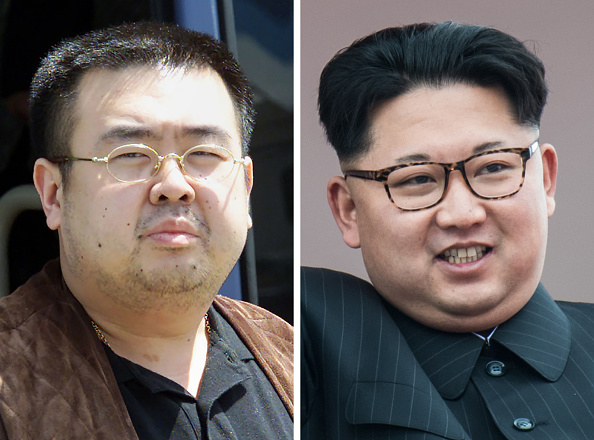
When the half brother of North Korea’s dictator was assassinated in an airport in Malaysia this past February, it looked to the world like an amateur assassination attempt—the two women who smeared him with a deadly nerve agent wore conspicuous clothing, and neither they nor the North Korean operatives working with them bothered to cover their faces. Furthermore, they chose a busy airport in Kuala Lumpur where security cameras were trained on their every move.
But that may have been intentional, a former member of South Korea’s intelligence agency said—it could have been a message to the world that North Korean leader Kim Jong Un is not to be messed with.
“Pyongyang wanted to send a worldwide message by murdering Kim Jong Nam in this gruesome, public way,” he said. “Jong Un wants to reign a long time and negotiate as a superpower. The only way to do that is to keep the world in fear of his weapons. He has a grand design, and this is part of it.”
The assassination followed two other assassination attempts—one in 2010 and another in 2012—after which Jong Nam reportedly wrote his brother, asking him to withdraw the order to punish his family, saying, “We have nowhere to hide,” GQ reported.
Nam had fallen out of favor with his father after he was caught in 2001 trying to travel to Japan to visit Disneyland on a Dominican Republic passport.
The youngest of the three Kim sons rose to power, and Kim Jong Nam was exiled.
The North Korean regime maintains that Kim Jong Nam died of a heart attack.
If Kim Jong Un did order his elder brother's assignation, this would be the second family member Kim has killed—he reportedly had his uncle, a mentor and his main adversary, executed in 2013 for attempts to “overthrow the state.”
A China affairs expert, Don Tse, told The Epoch Times that the uncle had been in talks with China to denuclearize North Korea.
“In 2012, when Jang Song Thaek [Kim Jong Un’s uncle] visited China and held secret talks with Hu Jintao and Premier Wen Jiabao, they discussed persuading Kim Jong Un to abandon nuclear testing, as well as the possibility that Kim Jong Un could be replaced by his brother, Kim Jong Nam,” Tse said.
But according to Tse, Hu’s efforts were undermined by the then-Chinese security czar, Zhou Yongkang, who was on the other side of a factional fight led by former Chinese leader Jiang Zemin.
“Zhou Yongkang leaked this information to Kim Jong Un, who had [his uncle] Jang purged,” Tse said.
Kim Jong Nam was reportedly critical of his family’s iron-fisted rule, and eventually settled down in Macau, a former Portuguese colony that was ceded to China in 1999.
While away from North Korea, he was still not safe. As soon as Kim Jong Nam left Macau, he was followed closely by North Korean spies, Nam Sung-wook said, citing contacts in South Korea's intelligence community.
“They had a group on his airplane. As soon as he arrived at the airport in Kuala Lumpur, another group followed him. They kept that surveillance up while he slept,” he told GQ.
The two women, who each administered parts of the VX nerve agent that together became a deadly compound, were from Vietnam and Indonesia. Their defense has argued they had no knowledge of the assassination plot.
One of the women told friends she thought they were doing pranks for a TV show, (which they had been practicing for for weeks) and the women’s lawyers argue that the reason they washed their hands after administering the liquid was because they were told to.
They are set to go before a judge in October. If convicted, they could face the death penalty.