


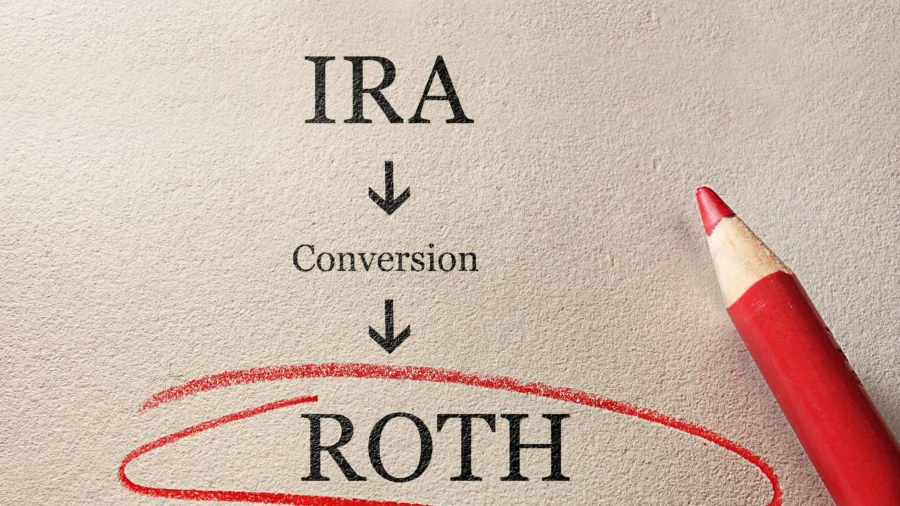
The idea of tax-free withdrawals from a retirement account can be very enticing. And you can accomplish that with a Roth IRA.
What Is a Roth Conversion?
A Roth conversion moves funds from a traditional IRA into a Roth IRA. You can generally transfer as much as you want into the Roth account. However, you’d owe ordinary income taxes on the amount converted.Make Staggered Conversions
Remember, you don’t need to convert the entire balance of your traditional IRA into a Roth IRA. In fact, this may raise some issues. The converted amount would be considered taxable income. So if the converted amount is large enough, it may push you into a higher tax bracket.But you can manage the taxation of a Roth conversion by making partial conversions over time. Some advisers recommend you convert enough in a given year to maximize your tax bracket, but not enough to push you into a higher one.
Take Advantage of the Sweet Spot
Some advisers recommend performing a Roth conversion during the “sweet spot.” This is generally considered to be the time between early retirement, but before you reach the required minimum distribution (RMD) age and before you begin collecting Social Security benefits. This is the time when your income would theoretically be low. So taxes on the conversion could be minimal.This move could also help you reduce future RMDs or eliminate them altogether. RMDs are minimum amounts of withdrawals most people saving in a tax-deferred account such as a traditional IRA must make every year once they reach age 73.
Because RMDs are treated as taxable income, they could trigger Social Security taxation and higher Medicare premiums, as well as push you into a higher tax bracket.
Consider Converting During Market Downturns
If you engage in a Roth conversion when your traditional IRA portfolio takes a hit, you are essentially moving a smaller amount of funds to the Roth account. This could minimize the tax impact of a conversion.Be Aware of the 5-Year Rule
In order to avoid the 10 percent early withdrawal penalty and taxes on the withdrawal of earnings from a Roth IRA, you must meet two conditions. First, you must be at least 59 1/2 years old.And you must wait a five-year holding period before withdrawing any converted balances. This is known as the five-year rule. And it applies separately to each conversion.
Pay the Taxes With Outside Money
You may want to avoid using money in your traditional IRA to pay taxes on the Roth conversion. You’d owe income taxes on that amount. And it could trigger a 10 percent early withdrawal penalty if you’re under the age of 59 1/2.Consider the Backdoor Roth IRA
Because of income limits, some high earners may not be allowed to directly contribute to a Roth IRA.For 2026, you can’t contribute any amount to a Roth IRA if your modified adjusted gross income exceeds $168,000 as a single filer or $252,000 if married and filing jointly.
But the tax situation can get complicated if you have any traditional IRAs for which you’ve made tax-deductible contributions into. And the five-year rule applies here too.
Be Aware of Tax Laws
Tax laws are constantly changing and these shifts can be significant. So it’s important to brush up on how the latest tax laws may impact your Roth conversion, based on your unique financial situation.The Bottom Line
A Roth conversion can give you access to key benefits that come with a Roth IRA. But the move could backfire and trigger serious tax consequences if you don’t proceed with caution. Still, you can consider making partial conversions over time, or doing a conversion when income is low or during market downturns. But timing your conversion and deciding the right amount to convert would be different for everyone based on their financial circumstances and goals. So it can help to discuss these strategies with a qualified tax adviser.The views and opinions expressed are those of the authors. They are meant for general informational purposes only and should not be construed or interpreted as a recommendation or solicitation. NTD does not provide investment, tax, legal, financial planning, estate planning, or any other personal finance advice. NTD holds no liability for the accuracy or timeliness of the information provided.
From The Epoch Times