


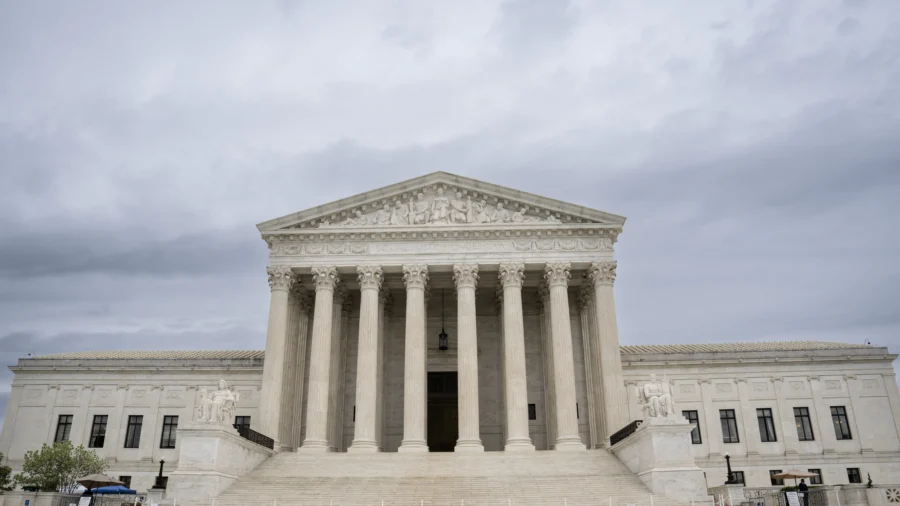
WASHINGTON—Absolving Cisco of its alleged complicity in aiding human rights abuses in China would risk encouraging more corporations to sell out business ethics for money, the Supreme Court heard on April 28.
The case in question, Cisco Systems v. Doe I et al., accused the California tech giant of knowingly developing a surveillance network for Beijing to go after practitioners of Falun Gong, a spiritual movement the regime has persecuted heavily since 1999.
Filed in 2011, the long-running lawsuit alleged that Cisco and top executives aided and abetted forced disappearance and systematic abuse of Falun Gong practitioners across China. The Supreme Court will decide if the 1789 Alien Tort Statute and the 1991 Torture Victim Protection Act allow for liability for international human rights violations.
Cisco has called the accusations unfounded and asked the Supreme Court to limit the scope of the law.
Paul Hoffman, an attorney for the Falun Gong plaintiffs, said that Cisco’s approach would free corporations’ liability no matter “how substantial and direct their contributions were.”
“Under Cisco's theory, even the corporate actors who provided the poison gas for Nazi crematoria would not be liable” under either of the laws, he told the justices.
‘Golden Shield’
First introduced to the public in 1992, Falun Gong teaches meditative exercises and spiritual principles based on truthfulness, compassion, and forbearance. Also known as Falun Dafa, it spread rapidly in China, attracting tens of millions of people. Deeming its popularity a threat, the Chinese regime began a nationwide persecution in 1999.The plaintiffs, Falun Gong practitioners, argued that this is where Cisco came into play.
The company, the lawsuit alleged, designed and customized “Golden Shield,” a surveillance platform that Chinese security forces can access throughout the country.
The plaintiffs include more than a dozen people, including at least one U.S. citizen, who said they have experienced detention, torture, and other abuses facilitated by Cisco’s technology.
A confidential Cisco marketing PowerPoint leaked in 2008 showed Cisco presenting Golden Shield as a tool to monitor public networks, with one portion mentioning the objective to “combat ‘Falun Gong.’”
Cisco lawyer Kannon Shanmugam pointed to only six cases in roughly 300 total involving the Alien Tort Statute in which plaintiffs successfully recovered monetary damages.
Hoffman responded later, saying he has been personally involved in more than six cases that won judgments.
Terri Marsh of the Human Rights Law Foundation, a nonprofit that sued Cisco on behalf of the Falun Gong practitioners, said she believes the argument presented on April 28 provided the justices with “information they the information they needed to hold Cisco accountable for their complicity in human rights violations against Falun Gong believers in China.”
“We hope that the justices will allow our lawsuit to proceed on the merits and we look forward to their decision,” she told The Epoch Times.
Broad Implications
Ahead of the oral argument, 18 briefs were submitted in support of the Falun Gong plaintiffs, including from members of Congress, human rights groups, legal scholars, former U.N. special monitors of torture, and former U.S. ambassadors-at-large for war crime issues and global criminal justice.Cisco and the U.S. solicitor general D. John Sauer say that allowing the case to proceed could hurt U.S. commercial activities. However, Harold Hongju Koh, an international law professor at Yale Law School who filed an amicus brief with the Supreme Court, said the assertions of commercial pain are “vastly overblown.”
Koh has served as the legal advisor and assistant secretary for human rights at the State Department. During three tours in the department, he said in a post published in digital law journal Just Security that he has seen the United States promoting aiding-and-abetting liability to hold international crimes perpetrators accountable in countries such as the former Yugoslavia, Rwanda, and before the International Criminal Court.
Koh said the allegations in the Cisco case go far beyond off-the-shelf sales or regular corporate activities. Instead, they appear to show a U.S. company crossing the line from a “passive supplier to knowing abettor,” he wrote in the brief.
Deputy solicitor general Curtis Gannon, who represented the Trump administration at the hearing, said lower courts have been “too permissive” in allowing such lawsuits to proceed. Justices Ketanji Brown Jackson and Sonia Sotomayor, appeared skeptical of his arguments.
Jackson noted that the U.S. government hasn’t taken a position that the aiding and abetting claim itself would create foreign policy problems.
“Why would Cisco be absolved and the plaintiffs here not get a remedy on the basis of some speculation about a foreign policy concern that the United States is not even willing to say in writing right now would actually occur?” the justice said.
The humanitarian group Oxfam also sided with the plaintiffs in a briefing signed by two recipients of the Nobel Prize in economic sciences.
The Electronic Frontier Foundation notes that the Cisco case has broad implications.
Victims of U.S. technology-powered abuses often have few options to seek redress in their own countries, so the Alien Tort Statute allows them to seek remedy, the foundation said.
The court, it said, should not "shut the courthouse door" on them.
The Supreme Court is expected to issue a ruling on the case by the end of June.