

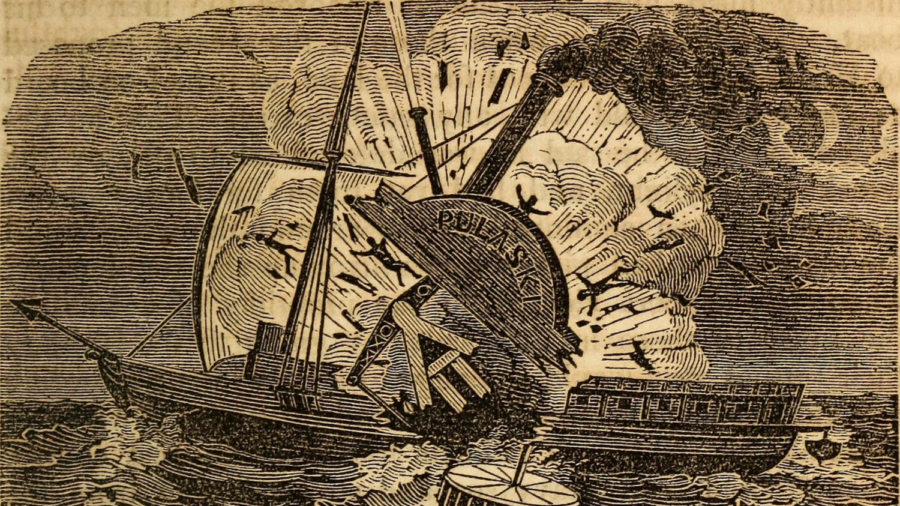
Two shipwreck salvage companies have found what they believe are the remains of the famous Pulaski steamship off the coast of North Carolina.
In 1838, the steamship sank to the bottom of the Atlantic after one of its boilers exploded.
The ship was traveling north from Savannah, Georgia, to Baltimore, Maryland, and was carrying such names as New York Congressman William Rochester and six members of the Lamar family, who were among the richest families in the southeast at the time.
Roughly 40 miles off the North Carolina coast, Blue Water Ventures International, which recovers historically relevant artifacts from shipwrecks, discovered what they thought might be the legacy of the powerful steamship.
They called in Endurance Exploration Group Inc., which specializes in shipwreck salvaging, and together they started exploring the underwater site.
Endurance Exploration Group President Micah Eldred said that the Pulaski was on its radar, and while they were interested in finding it, they weren’t planning to go after it till Blue Water Ventures reached out to them.
Since they started an extensive survey of the site last summer, they have found remnants of two boilers, passenger belongings, coins, and ship parts.
What makes them think that this was the Pulaski is the location, which they say matches up with witness accounts, the condition of the two boilers they found, and the discovery of machinery that would have been on that type of ship.
“Survivors say one of the boilers just blew apart and the other split up the side. And we have located those in that state,” Keith Webb, founder of Blue Water Ventures, told the Observer. “In my mind, there is no doubt this is the wreck of the Pulaski.”
They also haven’t found any coins that were produced later than 1838, the year the ship sank. Eldred said he believes the newest coin was from 1836 but said he also hasn’t seen all of them.
The currency recovered so far includes domestic currency that ranges from silver dollars to half dimes and similar denominations in the foreign currency.
“We’ve found a broad selection of coins, early American coins, foreign coins on the wreck site,” Eldred said in a phone interview. “This is not unexpected because Spanish silver was legal tender until 1857. Coins from other countries were accepted at the time because their value was based on weight.”
There’s isn’t much of the ship’s wooden body, Eldred said, but they have found some razor kits, dishware, lamps, and candlestick holders.
Dr. Joseph Schwarzer, director of the North Carolina Maritime Museums, told the Observer that positive identification of the Pulaski would require the ship’s bell, which would have the ship’s name etched on it, or identification numbers on the copper plating of the boilers.
Blue Water Ventures International told the Observer neither of those has been found.
Eldred said they will likely be working on this through 2018 and possibly into 2019 depending on how things progress.
Despite being only in the pre-salvage recovery stage, Eldred and Webb are already very confident that what they found is the remnants of the Pulaski.