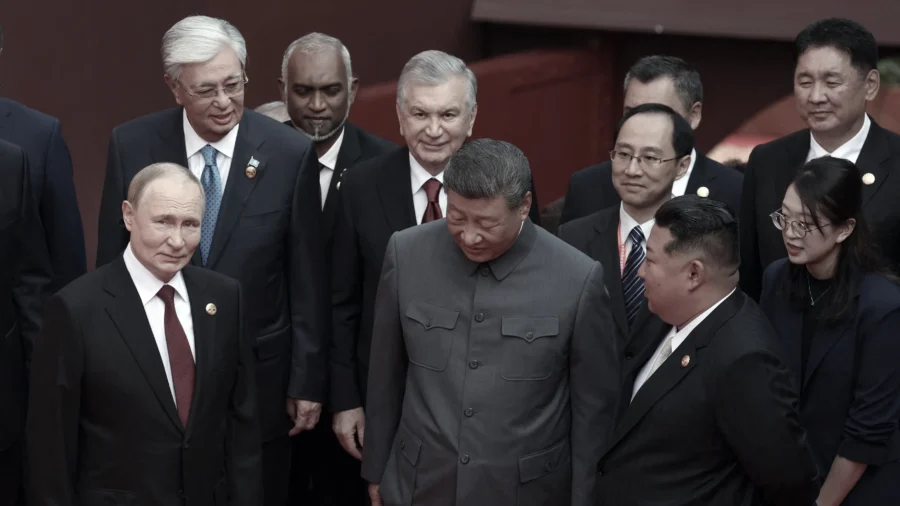
An advertisement that went viral on Chinese social media six years ago has resurfaced, drawing renewed interest after Chinese leader Xi Jinping and Russian President Vladimir Putin recently discussed "organ transplantation," "immortality," and "living to 150 years old" on their way to watch the Beijing military parade.
The 2019 advertisement, which focused on a military medical project to enhance Chinese leaders’ lifespans, caused suspicion of organ harvesting at the time and was then deleted, but it is now trending again on overseas social media platforms.
The topic of organ transplantation also reappeared as the exchange between Xi Jinping and Putin about longevity became a focal point of
some media reports.
On Sept. 3, live broadcasts by Chinese state media CCTV and rebroadcasts by global media outlets
showed that before the parade, Putin, through a translator, said to Xi, "Human organs will be continuously transplanted, leading to younger and younger lives, and perhaps even immortality." Xi responded, “Some predict that in this century, humans may live to 150 years.”
Reuters edited the conversation into a four-minute video and distributed it to over 1,000 media clients worldwide. However, after international media reported on issues regarding China's organ harvesting,
Reuters received a legal letter from CCTV demanding its removal and withdrew the legal permission to use it.
However, Putin later confirmed that he and Xi had discussed this longevity subject on the day of the parade."I think when we went to the parade, the chairman talked about it," Putin told reporters in Beijing when asked about the leaked chat,
Reuters reported.
In China, viewers watching on television did not hear the conversation between Xi Jinping and Putin, as CCTV's online broadcast covered the scene with music and pre-recorded narration.
On overseas social media platforms, Chinese users who "climbed over the [fire] wall" questioned whether Putin actually made those remarks and called for fact-checking.
The WeChat index for searches of "150"
spiked abnormally on Sept. 3, with the overall index value surging by 9,650.24 percent compared to the previous day, recording 3,368,513 searches. WeChat is a Chinese social media platform severely monitored by the Chinese Communist Party (CCP).
Project Designed to Lengthen CCP Leaders’ Lives
Xi Jinping’s talk about living to 150 is not a figment of imagination; it echoes a specialized research project conducted by the CCP to extend the lives of its top leaders.
In 2019, an
advertisement for People's Liberation Army (PLA) 301 Hospital's “
981 (CCP) Leaders’ Healthcare Project” offered elite medical services to extend the lifespans of senior CCP leaders to 150 years, sparking widespread controversy on Chinese social media before being deleted the following day.
The 301 Hospital, officially the PLA General Hospital, is the central and largest military medical institution in China, specializing in providing health care for senior party, government, and military officials.
The “981 Project” was established in 2005, and in 2014, the 981 Healthcare Technology Group was registered as a company.
The 2019 ad claimed the CCP started researching enhanced elite health care as soon as it seized power in 1949, developing a “unique system” that significantly extends leaders’ lifespans with “remarkable results.”
It cited data showing that “the average lifespan of Chinese leaders far exceeds that of leaders in Western developed countries of the same period.”
Specifically, it touted in 2008 the average lifespan of Chinese leaders reached 88 years, as opposed to
state statistics showing the average Chinese life span in 2008 was 73.
However, as online skepticism grew regarding CCP leaders extending their lives through specially supplied organs, the advertisement was quickly deleted after it went viral on WeChat.
The CCP’s top leaders have normally outlived most of their counterparts in the West. For example, Mao Zedong lived to 83, Zhou Enlai, Mao’s premier, lived to 78, and Zhu De, chairman of the Standing Committee of the National People's Congress, lived to 90, while the
average life expectancy in China at the time was 65.
Today, CCP leaders almost live close to or beyond 100 years. For instance, Deng Xiaoping, who suppressed the Tiananmen student movement, lived to 93; Jiang Zemin, former CCP leader, died at 96; former Premier Zhu Rongji is alive at 96; and
Song Ping, the oldest living former party and state leader, is 108 years old this year.
The “981 Project” advertisement highlighted their cutting-edge equipment and their exceptional medical team. However, many of their devices are imported from advanced Western countries, and their doctors have studied overseas.
This raises the question: why do leaders in Western countries, who also have access to advanced equipment and skilled doctors, have shorter lifespans than CCP leaders?
Forced Organ Harvesting
Steven Mosher, president of the Population Research Institute and China expert, has an answer.He told EpochTV's “American Thought Leaders” program in 2019 that in the 1960s, CCP leaders extended their lives by transfusing blood from young people, which had a genuine effect on longevity.
By the 1980s, they shifted to organ transplantation, initially intended to replace organs for CCP leaders to prolong their lives. Mosher said.
In 2006, The Epoch Times first reported on the CCP’s killing of prisoners of conscience for organ harvesting based on whistleblower testimony.
The China Tribunal, in its 2019 final judgment,
concluded beyond a reasonable doubt that forced organ harvesting has been occurring in China, with Falun Gong practitioners being the primary victims. The tribunal found that China's transplant industry relies significantly on organs sourced from these persecuted groups and other political dissidents, constituting crimes against humanity.
Falun Gong, also known as Falun Dafa, is an ancient mind and body practice and meditation, along with the study of the principles of truth, compassion, and forbearance. It’s been persecuted by the CCP since 1999.
Following the CCP’s persecution of Falun Gong, China’s organ transplant numbers skyrocketed.
According to investigations by the World Organization to Investigate the Persecution of Falun Gong, based on CCP official media
reports, China performed only 135 liver transplants in the 20 years before 1999, averaging 5–6 per year. However, from 1999 to 2006, liver transplants surged to 15,207, averaging over 1,700 annually—a 180-fold increase.
The tribunal added that there is no evidence this practice has ceased and confirmed it is ongoing.
Mosher
said he believes both the number of donors and transplant surgeries in China were fabricated. “We know how the system works,” he said. The CCP was willing to forcibly abort women at nine months of pregnancy, and kill babies by lethal injection at birth, so it's not going to “bat an eye at killing a political prisoner, or a Christian or a Falun Gong practitioner for their organs. If there is profit to be made at the other end, so much the better.”