


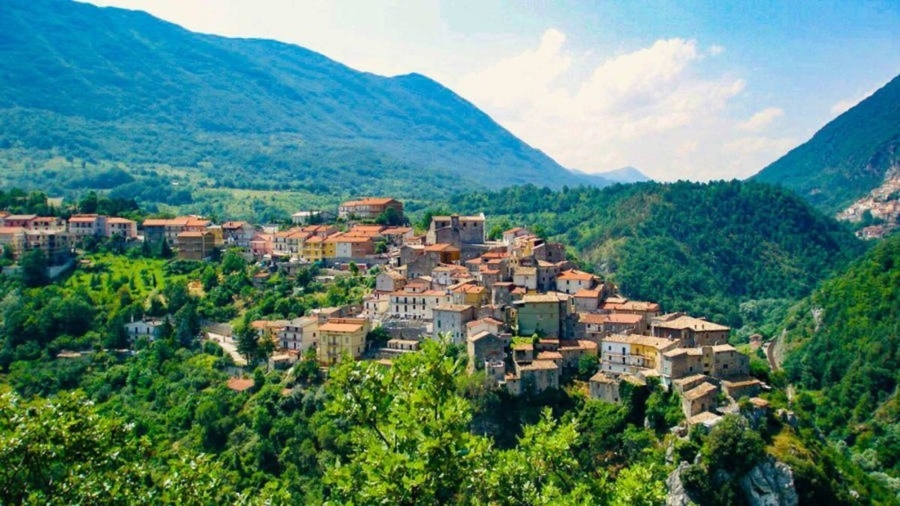
The region of Molise, a wild, beautiful but overlooked area that lies east of Rome, has announced it will pay people more than $27,000 to settle in one of 106 underpopulated villages. It's an effort to prevent their communities from dying.
Anyone who takes up the offer will receive 700 euros a month (about $770) for up to three years to help them settle in. It's an area known for its green pastures, olive groves, and snowy mountaintops.
There's a catch—they'll have to commit to starting a small business, in order to contribute to the local economy.
Young people and couples with children are particularly encouraged to apply to the scheme, which is to be officially launched on Sept. 16.
Depopulation Crisis
"The goal is to breathe new life and revamp the local economy," he says. "Newcomers are free to kick-start anything they please to get our financial support: a small inn; restaurant; bar; B&B; a tiny rural farm; artisan boutique; library, or shop selling local gourmet excellences."Thousands of people have left Molise in recent years. Official statistics say the number of people living there has fallen by almost 9,000 since 2014, pushing the region's population to just 305,000.
Now one of Italy's most depopulated regions, 106 of its 136 towns has fewer than 2,000 residents.
Many communities across Italy are at risk of being lost. Younger people migrate to bigger towns and cities—or abroad—in search of work as Italy's fragile economy struggles to support its more remote, rural areas.
Recently, there's been a spate of villages from the northern Alps to the southern vineyards of Sicily, virtually giving away homes. Anyone willing to spend the money on renovating them can move in.
Molise's offer has the potential to be the most lucrative yet for anyone willing to take the plunge.
Fornelli
Fornelli is known as the City of Oil because of the olive groves dotting a landscape that also harbors premium truffles and species of endangered legumes.Nominated for the 2019's Italy's Most Beautiful Town contest. It has a medieval center that was once protected by a drawbridge and is now a web of narrow alleys and arched entrances.
Pesche
Clinging to the rocky cliff side of Mount San Marco, this village takes its name from the Italian word pietre, meaning "rocks."The white-yellowish stone dwellings at the feet of a majestic castle contrast with the green-brownish stones covered in lush vegetation that cover the landscape.
Riccia
One of the high spots of the year in Riccia is a picturesque grape festival that celebrates the end of the vendemmia or harvest and attracts wine lovers from across Italy.The event sees floats decorated with grapes parade through the cobbled streets as actors hand out gourmet treats.
Riccia, clustered at the feet of a cylindrical tower, is part of an élite club uniting Italy's "authentic villages" where traditions and ancient recipes survive.
Capracotta and Campitello Matese
These villages are for ski lovers.One of the attractions of Molise, Italy's second smallest region, is that it has everything in one place: sea, lakes, forests, and even the Apennine mountain range.
Capracotta and Campitello Matese are the region's top winter sports resorts, pulling in snowboarders and cross-country amateurs.
Pietrabbondante and Sepino
It's hard to believe, but Molise rivals Rome or Pompeii for ancient architecture and archeological attractions.The two small villages of Pietrabbondante and Sepino both contain the secret, mostly unknown ruins of once-glorious citadels.
A large chunk of Molise used to lie within the kingdom of the fiery Samnite tribes who refused to bend the knee to Ancient Rome but were eventually slaughtered.
Pietrabbondante's archeological area, close to the town and set at an altitude of 1,000 meters, has a spellbinding view over Molise's rugged hills and features a sanctuary and several temples.
San Giovanni in Galdo
Grazing sheep, cows, and buffalo dot the rustic landscape here.It's still possible to spot forgotten dusty trails winding up the mountains and the ruins of a majestic Italic temple built in the third century BCE.
San Giovanni in Galdo is located near one of Molise's main routes used by shepherds to move their livestock between low and high pastures.
The old town, dubbed Morrutto or "broken walls" in the local dialect, is a maze of caves and underground chambers.
Castel San Vincenzo
The clear waters of its blue lake make Castel San Vincenzo one of Molise's most visited towns by day-trippers.Set in the Alta Valle del Volturno, it's known as the Valley of Faith, because monks and pilgrims have, for centuries, come here for meditation and prayer.
Duronia
The village, dating back to pre-Roman times, is a collection of pastel-colored peasant houses connected by staircases and nestled at the feet of an overhanging fortress.The town's symbol is a huge stone cross. Its belvedere piazza offers a unique panorama of surrounding meadows dotted with the ruins of Samnite towers.
Duronia is famous for guided trekking tours along rural routes.
The foodie Scattone festival celebrates an iconic pasta dish made with red wine and pepper that's said to offer strength and ward off influenza.