


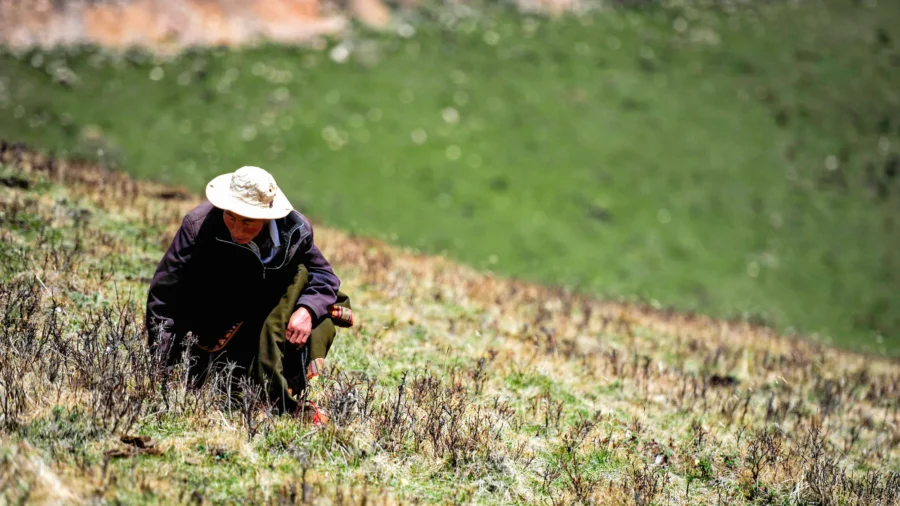
Residents in northwestern China have recently reported multiple cases of Tibetan brown bears appearing in their local areas, attacking people, killing livestock, and damaging houses.
Villagers and herders in Tibet and China’s northwestern Qinghai Province are the main victims of bear attacks, as their habitats often overlap with those of Tibetan brown bears.
Tibetan brown bears, also called Tibetan blue bears, are currently found mainly in the high-altitude regions of the Tibetan Plateau, including Tibet and Qinghai Province. They weigh about 95 to 780 kilograms (209 to 1,720 pounds), run fast, and are considered the most dangerous species on the Tibetan Plateau.
In recent interviews with The Epoch Times, several residents talked about their personal encounters with bears on condition of anonymity for fear of reprisal.
A villager in Baqing County, Nagqu City, Tibet, said there is now “no way to deal with the bears,” because Tibetan brown bears are classified as a second-class nationally protected species. According to Chinese criminal law, second-class nationally protected animals are classified as rare or endangered species under state protection. The illegal hunting, killing, purchase, transport, or sale of such protected wildlife and their products constitutes a criminal offense punishable by five to 10 years in prison, along with fines.
Attacks on People and Livestock
Local residents mainly make a living by herding cattle, gathering caterpillar fungus, and growing barley. Whether they are grazing livestock or heading into the mountains to collect fungus and medicinal herbs, they face the risk of bear attacks.The villager in Zadoi County, Qinghai Province, said bear attacks happen there almost every year, but that “the past few years have been especially bad.” Bears now even come right up to homes, damaging property and attacking people and livestock.
The villager said that last June alone, several people in the village were attacked by bears. “One child was literally eaten alive by a bear,” the villager said, adding that the child’s mother suffered a mental breakdown afterward. His brother-in-law was also attacked, with the bear tearing off part of his scalp and face. He survived only because others came in time to rescue him.
“If you really run into a bear, nothing works,” he said. Bears now appear both day and night, he added, and people are afraid to go out alone. When they do go out, they try to stay in open areas or where there are more people.
The villager in Baqing County, Nagqu, Tibet, also told The Epoch Times that Tibetan brown bears had repeatedly broken into his family’s home, rummaging through furniture, grain, and beef supplies. Fortunately, no one was home at the time.
A herder in Tanggula Township, Golmud, Qinghai, told The Epoch Times that just a few days earlier, after his family relocated to a new pasture and moved their supplies and food into the new shelter, a Tibetan brown bear broke in that same night and trashed the place.
Authorities Dismiss Claims
On May 1, Dingqing County authorities issued a statement saying no fatal bear attacks had occurred there in recent years, urging the public “not to believe, spread, or fabricate rumors.” The notice added that police would crack down on anyone spreading rumors or disrupting public order online.'Government Won't Do a Thing'
Residents who spoke with The Epoch Times claim they have suffered attacks, house break-ins, and livestock depredation from bears and have received little help, protection, or compensation from local authorities.“If your livestock or home gets attacked, you’re basically on your own—the government won’t do a thing,” the herder from Tanggula Township said.