


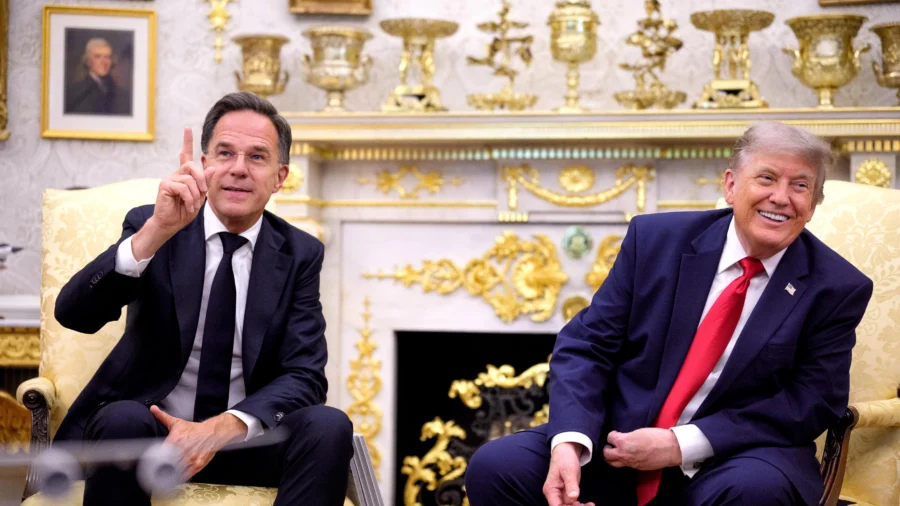
WASHINGTON—While hosting NATO Secretary-General Mark Rutte at the White House on June 24, U.S. President Donald Trump said the other members of the transatlantic alliance should show a greater sense of loyalty going forward.
As he returned to the White House last year, Trump championed a push for NATO members to commit to spending more of their respective annual gross domestic product on bolstering their militaries. He has since pressed for the European alliance members to take on greater responsibility for the security of the continent.
When asked during an Oval Office press conference on June 23 what more the alliance members could do, Trump said, “I just want their loyalty.”
He added: “We don’t need their money, we don’t need anything. We have the most powerful military in the world by far, but I just want loyalty.”
Trump recently raised frustrations over the level of alliance support for U.S. military operations against Iran, which began on Feb. 28. At times, the Trump administration has clashed with European nations that blocked U.S. forces from using their bases and airspace to support offensive operations against Iran.
Rutte broadly defended the record of European NATO members during the recent clashes with Iran.
“I know there have been isolated cases about which you are really disappointed, but generally speaking, your European allies have been there with you,” Rutte said.
The NATO secretary-general said between 4,000 and 5,000 U.S. aircraft took off from bases in Europe during the course of the hostilities with Iran. He described other instances in which airports in Romania slowed commercial traffic to accommodate U.S. aircraft.
“I would argue it would have been very difficult to do Iran without having Europe as a power projection platform for the United States,” Rutte said.
Trump’s criticisms of the alliance are not limited to the recent Iran conflict.
During the Oval Office press conference on June 23, Trump also reiterated concerns about NATO members meeting their military spending obligations.
Last year, amid Trump’s urging, alliance members adopted a commitment to spend 5 percent of their GDP on their respective defenses. The commitment specifically entailed each member spending 3.5 percent of its GDP on core military capabilities and a further 1.5 percent on critical infrastructure and industrial capacity.
“The big question is, are they paying the 5 percent?” Trump said during the Oval Office press conference. “They agreed six months ago when we were together to pay 5 percent and, for the most part, they’re not paying.”
Rutte said the alliance, overall, has seen an increase in defense spending. The NATO secretary-general calculated the increase at more than $1 trillion since the start of Trump’s first term in 2017, and referred to this increase as the “Trump Trillion.”
“Going forward, our annual NATO dues will be contingent on other countries meeting their defense spending targets. Where other allies do not spend with urgency, our dues contributions will go down,” Hegseth said.