

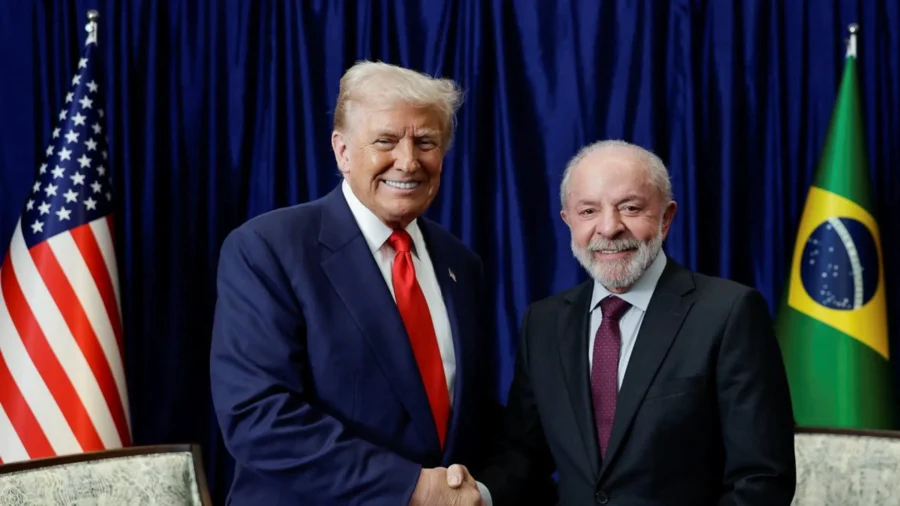
WASHINGTON—U.S. President Donald Trump said on May 7 that his meeting with Brazilian President Luiz Inácio Lula da Silva at the White House was productive, noting that both sides will continue to address bilateral matters.
The leaders first held a meeting in the Oval Office, followed by lunch in the Cabinet Room.
“Just concluded my meeting with Luiz Inácio Lula da Silva, the very dynamic President of Brazil,” Trump wrote on Truth Social. “We discussed many topics, including Trade and, specifically, Tariffs.
“The meeting went very well. Our Representatives are scheduled to get together to discuss certain key elements. Additional meetings will be scheduled over the coming months, as necessary.”
Cameras and reporters were kept out of the Oval Office during the meeting between the two leaders. According to Brazilian officials, Lula asked Trump to begin the meeting first and speak to reporters afterward. However, the press meeting never took place. Lula later spoke to reporters at the Brazilian Embassy in Washington.
Before the meeting, a White House official told The Epoch Times that both leaders would focus on “economic and security matters of shared importance.”
This was the third time that the leaders met in person and their second formal bilateral meeting.
Brazil’s general elections are set for Oct. 4, and if the race heads to a presidential runoff, polls suggest that Sen. Flávio Bolsonaro, son of the jailed former president Jair Bolsonaro, is currently leading Lula.
One of the most pressing issues on the agenda during Lula’s visit was whether Washington would label Brazil’s two most powerful criminal organizations—Primeiro Comando da Capital and Comando Vermelho—as terrorist groups.
The Trump administration has broadened terrorism designations to include criminal groups throughout Latin America, including Venezuelan gangs, Mexican cartels, and other transnational organizations. The Brazilian government said it would view such a designation as an infringement on its sovereignty.
“We discussed issues that used to be taboo, such as organized crime,” Lula said during the news briefing at the embassy.
“We discussed creating a working group involving all countries in Latin America and around the world to combat organized crime. This is something that needs to be shared by everyone. Part of the weapons that arrive in Brazil come from the United States.”
Lula said he believed that by creating a working group, countries could achieve in a few years what might otherwise take centuries to accomplish.
Another important topic on the agenda was ongoing trade tensions.
Last year, Trump set tariffs as high as 50 percent on Brazilian goods, saying that Brazil’s prosecution of Jair Bolsonaro was a “witch hunt.” Later, he removed several products from these tariffs to combat U.S. inflation, such as coffee, beef, orange juice, fruit, minerals, fuels, aircraft, and fertilizers.
When the U.S. Supreme Court struck down reciprocal tariffs in February, the Trump administration responded by setting a new global tariff of 10 percent under Section 122 of the Trade Act of 1974.
At the same time, Washington has launched investigations into “unfair trade practices” under Section 301. Brazilian officials worry that the probe could lead to a new 30 percent tariff on products that are currently exempt.
Lula told reporters that he proposed creating a bilateral working group to address U.S. trade concerns, including tariffs, and signaled that Brazil is open to “concessions” to reach a deal.
The U.S. trade surplus with Brazil in goods was $14.4 billion in 2025.
Pressure has also increased in other areas. The U.S. Department of Justice recently opened an investigation into alleged competition violations in the meat processing industry, a move that could affect several Brazilian companies.
Meanwhile, the United States is seeking to secure its rare-earth mineral supply chains and reduce its reliance on China. Brazil has the world’s second-largest reserves of rare earths and has become strategically important for the United States.
“We want to share this potential with anyone willing to invest in Brazil,” Lula told reporters. “We have no preference. We want partnerships. Whoever wants to invest is being invited to come to Brazil.”
Brazil is a founding member of BRICS, which originally consisted of Brazil, Russia, India, China, and South Africa. The bloc has recently accelerated efforts toward de-dollarization and expanded to include Egypt, Ethiopia, Iran, the United Arab Emirates, Saudi Arabia, and Indonesia.