



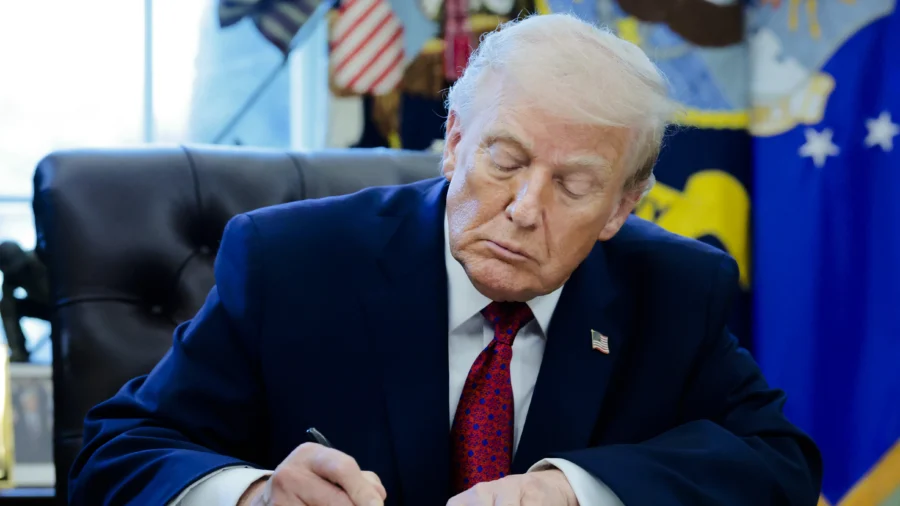
President Donald Trump signed the National Defense Authorization Act (NDAA) on Dec. 18, authorizing $901 billion in military and national security programs for Fiscal Year 2026.
The $901 billion topline authorization comes as a compromise between the House, which initially sought an $893 billion authorization, and the Senate, which initially sought $925 billion.
While the NDAA provides the authority for various military and national security programs in a given year, the actual funding comes in a separate appropriation bill.
The annual defense authorization typically covers weapons development and procurement programs. This year's more than 3,000-page authorization supports Trump's Golden Dome missile defense initiative and the continued development of the U.S. Air Force's next-generation stealth fighter, dubbed the F-47. Other lines of authorization support existing weapons systems, land vehicles, aircraft, and shipbuilding efforts.
Beyond authorizing weapons programs, the NDAA authorizes recruitment and end-strength figures for the military branches for the year.
"This NDAA includes the critical SAFER SKIES Act, which provides authorities to defeat drones when they present a threat to the public and contains language to expand counter-drone authorities," the White House wrote last week.
The White House praised additional provisions addressing quality of life matters for U.S. military personnel and their families, including a 3.8 percent pay raise and child care support for military personnel.
In recent years, NDAAs have covered more partisan topics in the military, including policies addressing diversity, equity, and inclusion (DEI) programs and issues of gender identification and sexual orientation.
The White House highlighted provisions in this year's bill that curtail DEI programs within the military and a provision blocking males who are attending military service academies from competing in athletic competitions designated for women.
"This NDAA will enable the Department of War (DoW) to carry out President Trump’s Peace Through Strength agenda, protect the homeland, and strengthen the defense industrial base, while eliminating funding for wasteful and radical programs that undermine the warfighting ethos of our Nation’s men and women in uniform," the White House wrote.
Another provision in the NDAA blocks the Pentagon from using funds to reduce force levels below 76,000 personnel in Europe or withdraw from any bases there without the war secretary and the commander of the U.S. European Command first certifying to Congress that they consulted European allies and determined that such moves were in the interests of U.S. national security.
After Trump signed the legislation, he said he supported the objectives of the act but had concerns about some provisions. For multiple provisions, he indicated they could conflict with his authority and said he would interpret them in a way that’s consistent with the Constitution.
For example, he said some provisions “purport to dictate the position of the United States in external military and foreign affairs.”
The NDAA also includes a provision limiting the war secretary's travel budget unless he provides Congress with unedited footage of recent military strikes on suspected drug boats operating around Latin America. This provision comes amid recent congressional scrutiny over a Sept. 2 operation, in which U.S. forces conducted follow-up strikes that killed survivors of an initial attack on a vessel operating in the Caribbean.
The Senate passed a separate aviation safety bill this week, titled the Rotorcraft Operations Transparency and Oversight Reform Act, or the ROTOR Act, which requires military aircraft operating in the District of Columbia to transmit their locations at all times, with limited exceptions. Sponsored by Sen. Ted Cruz (R-Texas), the ROTOR Act bill was recently amended to address a provision in this year's NDAA that would have provided more waivers for military aircraft to operate in the airspace around the national capital without transmitting their locations.
Cruz initially sponsored the ROTOR Act legislation after a deadly crash over the Potomac River near Ronald Reagan National Airport in Washington in January, in which a passenger airliner and military helicopter collided. The crash killed all 67 people aboard the two aircraft.
Accident investigators determined that the military helicopter involved in the January crash was not transmitting its location before it crossed into the flight path of the passenger airliner.
The Senate fast-tracked Cruz's bill, but it still has to pass in a separate House vote and receive Trump's signature before it can override the military flight provisions contained in the current NDAA.