


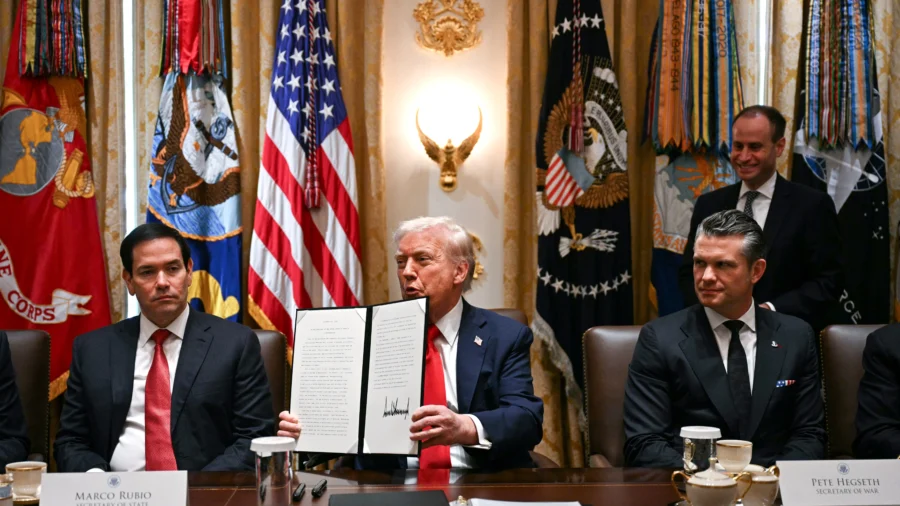
The signing took place ahead of a Cabinet meeting.
Acknowledging that “some say it’s controversial,” Trump reaffirmed his commitment to celebrating Columbus’s legacy.
With the signing, the president formally designated Oct. 13 as Columbus Day, calling on Americans to observe it with “appropriate ceremonies and activities.”
Scharf described Columbus as “a great Italian explorer” whose 1492 voyage across the Atlantic is a “particularly important holiday for Italian Americans who celebrate the legacy of Christopher Columbus and the innovation and explorer zeal that he represented.”
After signing the document, Trump said, “In other words, we’re calling it Columbus Day,” to cheers from the room. “I’ve never seen that happen. The press actually broke out in applause. Good. Columbus Day. We’re back. Columbus Day. We’re back, Italians. We love the Italians.”
The proclamation honored Columbus as “the original American hero, a giant of Western civilization,” and pledged to reclaim his legacy of faith, courage, and perseverance from those who, it said, sought to “destroy his name and dishonor his memory.”
“Under my leadership, those days are finally over,” the document stated. “Our Nation will now abide by a simple truth: Christopher Columbus was a true American hero, and every citizen is eternally indebted to his relentless determination.”
Promise Made by Trump
The move fulfills Trump’s promise earlier this year to “bring Columbus Day back from the ashes,” after stating that Democrats were tarnishing the explorer’s legacy. “They tore down his statues and put up nothing but ‘woke,’ or even worse, nothing at all,” Trump said in an April post on Truth Social.Berkeley, California, became the first city to officially recognize Indigenous Peoples Day in 1992. Since then, other cities and states have adopted the observance. In 2021, President Joe Biden was the first president to issue a federal proclamation officially recognizing Indigenous Peoples Day on Oct. 11, issuing one each year during his presidency.