


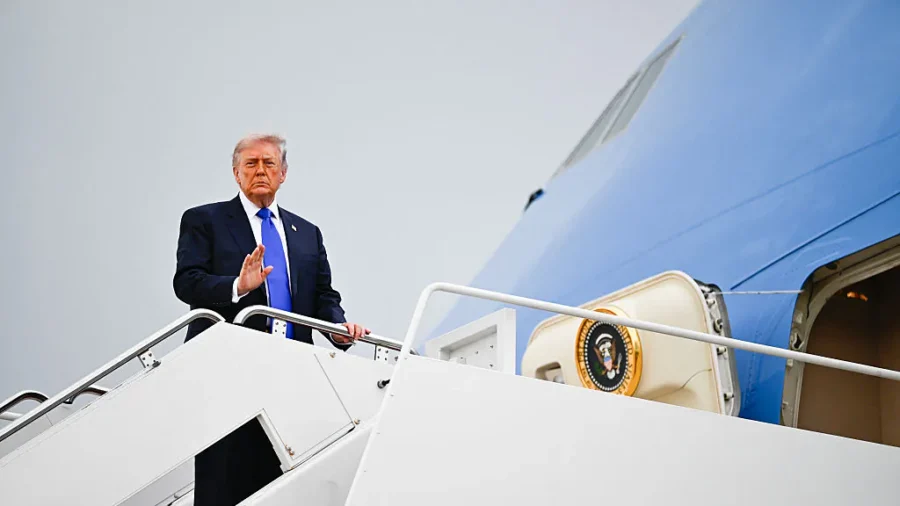
President Donald Trump has suggested that the United States or potentially China could enter Iran in the future to remove nuclear material after the 2025 strikes on Iran's nuclear facilities.
"At the right time, we'll either go in, or we'll get it. I think we'll probably get it, but if we don't get it, we'll go in,” Trump told reporters on May 15 as he was departing China, saying that "nuclear dust," referring to enriched uranium, still needs to be removed from the country.
Trump said that a top Iranian official told his administration that the United States and "possibly China" can remove the "nuclear dust" from the "disaster" that remained after U.S. strikes against the country's nuclear facilities last year.
When asked about a possible war being triggered by the U.S. military entering Iran, Trump said: “I think they'll be totally defeated. And we won't have any risk. We have the equipment to take it out; nobody else does. China might have the equipment.”
The president did not elaborate on when or how such an operation would take place, but he told reporters that Iran does not "have the technology" to remove the nuclear material.
In the summer of 2025, the United States and Israel launched strikes on Iranian nuclear facilities in what was dubbed "Operation Midnight Hammer." At the time, Iranian Foreign Minister Abbas Araghchi told reporters that Iran's nuclear sites sustained severe damage during the strikes.
In a recent interview with Fox News' Sean Hannity, Trump said Iran is unable to reach the nuclear material because a "mountain collapsed on it" and that only China and the United States can reach the material.
Trump has long said that Tehran cannot obtain a nuclear weapon, while Iranian officials have denied that the regime is using its nuclear program to produce weapons and have insisted it's meant for civilian purposes.
On Friday, the president commented on a recent peace proposal that was submitted by Iran but said it was problematic because it did not offer strong enough guarantees on the country's nuclear program.
"If they have any nuclear of any form, I don't read the rest of it,” Trump told reporters.
He said he would accept a 20-year moratorium on nuclear weapons.
The head of the U.S. command that is overseeing operations against Iran said that more than 90 percent of the country's mines have been destroyed in the ongoing conflict.
Adm. Brad Cooper of U.S. Central Command (CENTCOM) told the Senate Armed Services Committee on Thursday that hundreds of U.S. airstrikes have mostly destroyed Iran’s “once-massive inventory” of sea mines. He did not say how many were laid in the Strait of Hormuz.
"The Iranian ability to stop commerce has been dramatically degraded through the straits, but their voice is very loud, and those threats are clearly heard by the merchant industry and the insurance industry," Cooper told lawmakers in the hearing.
On Friday, CENTCOM released an update on its naval blockade of Iranian ports, saying that at least 75 commercial vessels heading to or from Iran have been redirected or stopped.
Another four ships have been "disabled to ensure compliance," the military command said in a post on X, including a photo and information about a U.S. military helicopter taking off from the USS Rafael Peralta destroyer.
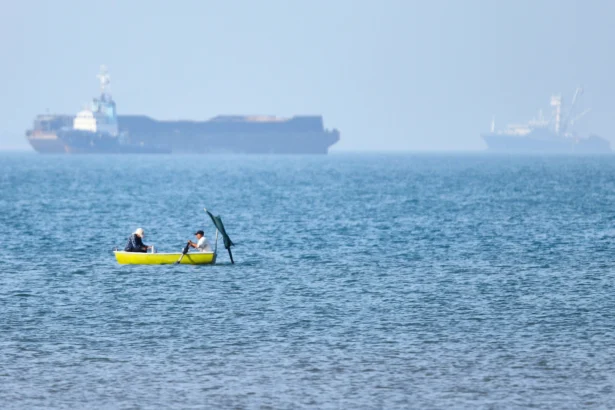
Aside from mines, Iran's military still retains a "very moderate, if not small, capability to continue strikes," Cooper told the Senate committee. "And we, of course, have accordingly prepared for such a contingency," he added.
Iran was not only militarily weakened at home but also in the broader Middle East, Cooper said, adding that Tehran is no longer able to transfer arms and other resources to some of its allies in the region, such as Hezbollah in Lebanon, Hamas in Gaza, and the Houthis in Yemen.
"Those transfer paths and methods have been cut off," he said.