


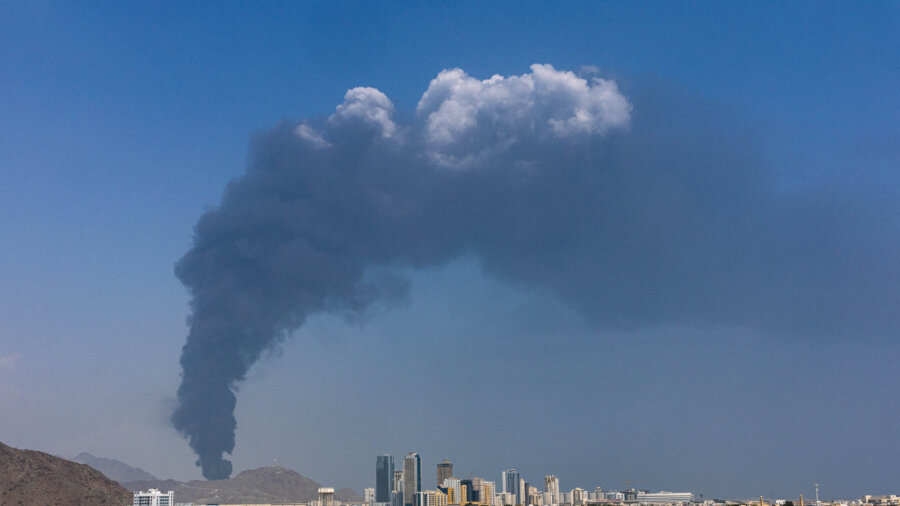
The United Arab Emirates is actively engaging with missile and drone attacks from Iran, the country’s defense ministry said in a post on X on Tuesday, in what appears to be the second day of Iranian attacks on the Gulf nation.
UAE air defense systems "are currently dealing with missile and drone attacks originating from Iran," the Gulf Arab nation's Ministry of Defense wrote on X about the new round of attacks, adding that the air defenses are also "actively engaging" with drone threats.
The country's ministry reported that "sounds heard in scattered areas of the country are the result of the UAE's air defense systems intercepting ballistic missiles, cruise missiles, and drones."
The announcement came as U.S. Department of War Secretary Pete Hegseth on Tuesday morning warned Iran that attacks on military assets or commercial shipping vessels would prompt the United States to respond with "overwhelming and devastating" force.
"We prefer this to be a peaceful operation, but are locked and loaded to defend our people, our ships, our aircraft, and this mission," Hegseth said in a press conference at the Pentagon alongside Joint Chiefs of Staff Chairman Gen. Dan Caine.
U.S. forces exchanged fire with Iranian forces on Monday in the Strait of Hormuz, the key waterway used for transporting large amounts of oil and natural gas to the rest of the world from the Persian Gulf.
Last week, the country's top leader, Mojtaba Khamenei, said in a statement through state-run media that new legal rules were drafted by Iran to manage the strait, although the Trump administration has said that such proposals are a nonstarter in peace negotiations.
"We're not looking for a fight," Hegseth said at the press conference. "But Iran also cannot be allowed to block innocent countries and their goods from an international waterway."
The head of U.S. Central Command (CENTCOM), Adm. Brad Cooper, said on Monday that six small Iranian boats were eliminated by U.S. forces during the recent bout of fighting.
"The cruise missiles were going after both U.S. Navy ships, but mostly after commercial shipping," Cooper said. "We defended both ourselves and, consistent with our commitment, we defended all the commercial ships.
"We've had drones launched against commercial ships, all of which were defended against, consistent with our commitment. And then the small boats were all going against commercial ships, and all were sunk by Apaches and Seahawk helicopters."
Also in the news conference, Hegseth and Caine both said that the U.S. ceasefire with Iran hasn't ended despite the new military activity in the region. A ceasefire was announced last month and was later extended by President Donald Trump, while U.S. forces continue to implement a blockade of Iranian ports.
“Since the ceasefire was announced, Iran has fired at commercial vessels nine times and seized two container ships, and they’ve attacked U.S. forces more than ten times—all below the threshold of restarting major combat operations at this point,” Caine said Tuesday.
Over the weekend, the president announced on Truth Social that the U.S. military would protect commercial ships in the strait as part of what he termed "Project Freedom."