


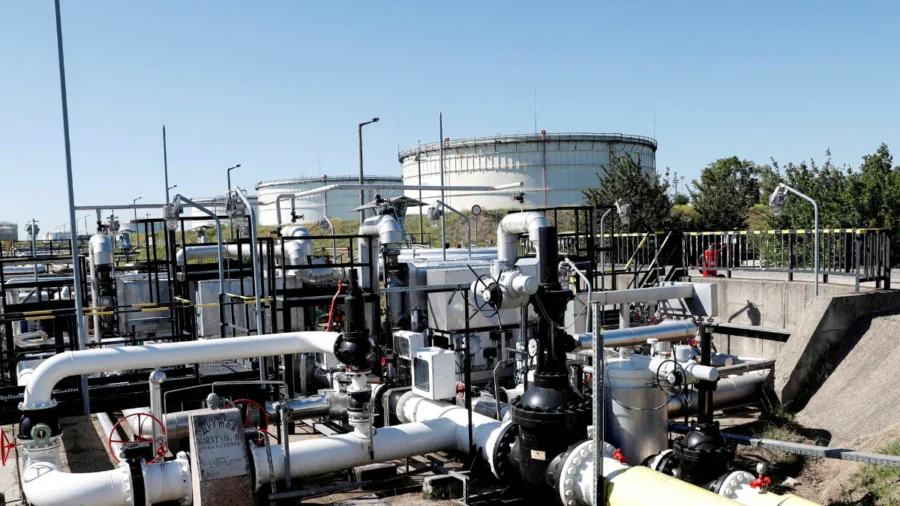
Ukraine has accepted the European Union’s offer of technical support and funding to restore oil flows through the damaged Druzhba pipeline.
The Druzhba pipeline is a roughly 2,485-mile artery carrying Russian oil into the landlocked heart of Europe. Damage to the pipeline has disrupted crude oil supplies to Hungary and Slovakia.
European Commission President Ursula von der Leyen and European Council President António Costa said in a March 17 joint statement that Ukraine had “welcomed and accepted” the offer, adding that European experts would be available to assist Kyiv immediately.
“Our priority is to ensure energy security for all European citizens,” they said. “In this sense, the President of the European Commission and the President of the European Council will continue to work with the concerned parties on alternative routes for the transit of non-Russian crude oil to the countries of Central and Eastern Europe.”
Damage to the pipeline in Ukraine has become a source of friction between Kyiv and Budapest and Bratislava, with the latter two being importers of Russian oil through the pipeline that travels through Ukraine.
Budapest and Bratislava have said Kyiv is delaying the resumption of oil flows through the pipeline.
Hungary Vetoes Ukraine Aid
Last month, Hungarian Prime Minister Viktor Orban vetoed a 90 billion euro ($104 billion) loan from the EU to cover Ukraine’s military and economic needs for the next two years—an issue that von der Leyen and Costa acknowledged in their letter to Zelenskyy in which they laid out the offer of support.In the March 16 letter, Cost and von der Leyen said that “Hungary has explicitly informed us that they are currently not in a position to agree with the proposed revision of the Multi-Annual Financial Framework that underpins the 90 billion Ukraine Support Loan nor to adopt the 20th package of economic sanctions against Russia.”
Unanimous support from all EU members is required for both to pass.

He welcomed and accepted the support, informing the EU that he would ask the CEO of energy company Naftogas to contact the EU ambassador to take it forward.
Zelenskyy also reiterated his previous denial that Ukraine was intentionally delaying repairs, calling the claims unfounded.
No Oil Deliveries, No Money
Hungarian Foreign Minister Peter Szijjarto called the EU’s arrangement to help Ukraine fix the pipeline a “political game” orchestrated between Brussels and Kyiv.
Orban said he had earlier told Costa that Hungary’s position “remains unchanged,” per translations accompanying the video.
“If president Zelenskyy wants to receive his money from Brussels, then he must reopen the [Druzhba] oil pipeline,” the Hungarian prime minister said. “If there is no oil, there is no money.”
Slovak Foreign Minister Juraj Blanar said several timelines had been announced in the past and that the situation should be verified directly by experts.
“We have once again been informed that, according to #Ukraine, the Druzhba oil pipeline could be operational in up to six weeks,” Blanár said in a post on X.
“However, several such timelines have already been announced in the past. We therefore consider it necessary to verify the situation directly on site, with the participation of experts who could also assist with any necessary repairs to the pipeline.”