


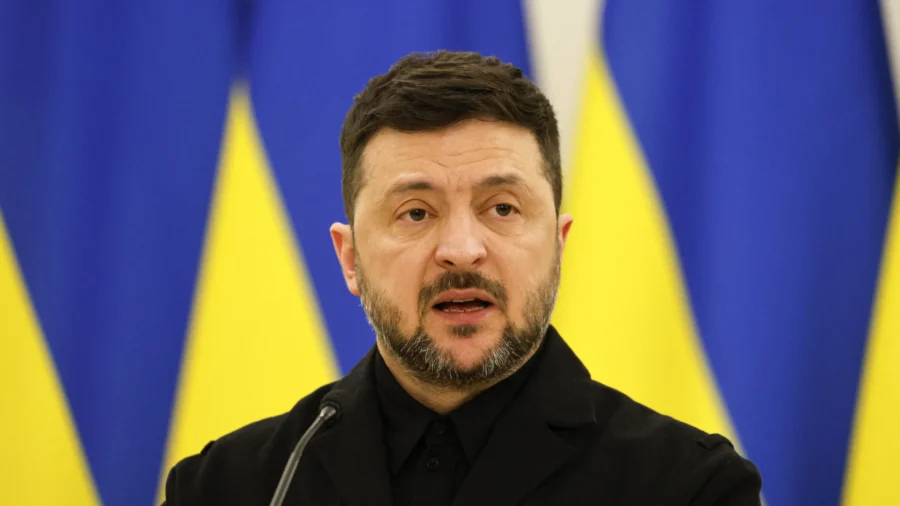
Ukrainian President Volodymyr Zelenskyy said on April 28 that Israel's purchase of grain from Russian-occupied Ukrainian territory "cannot be legitimate business," adding that Ukraine is preparing sanctions against those profiting from the sale.
Zelenskyy described the grain as "stolen goods" in a post on X, saying that the "Israeli authorities cannot be unaware of which ships are arriving at the country’s ports and what cargo they are carrying."
"Russia is systematically seizing grain on temporarily occupied Ukrainian land and organizing its export through individuals linked to the occupiers," Zelenskyy added. "Such schemes violate the laws of the State of Israel itself."
He said that Ukraine had taken all the necessary diplomatic steps to prevent incidents such as these occurring, but that another vessel transporting such grain had not been prevented from docking in Israel.
"Based on information from our intelligence services, Ukraine is preparing a relevant sanctions package that will cover both those directly transporting this grain and the individuals and legal entities attempting to profit from this criminal scheme," Zelenskyy continued, adding that Ukraine would also be coordinating with its European partners to "ensure that the relevant individuals are included in European sanctions regimes."
"We expect that the Israeli authorities will respect Ukraine and refrain from actions that undermine our bilateral relations," he concluded.
Kyiv considers all grain produced in the four regions Russia claimed since launching its full-scale invasion of the country in 2022, as well as Crimea, annexed by Moscow in 2014, to have been stolen and has previously protested its export to other countries.
While Russia calls the regions its "new territories," they are still internationally recognized as Ukrainian, and Moscow has not commented on the legal status of the grain harvested from them.
Ukraine's Foreign Minister Andrii Sybiha said in a post on X on April 27 that Israel's ambassador had been summoned over what he described as Israeli inaction in allowing shipments of grain to enter the country from Russian-occupied Ukraine.
"It is difficult to understand Israel’s lack of appropriate response to Ukraine’s legitimate request regarding the previous vessel that delivered stolen goods to Haifa," Sybiha wrote.
"Now that another such vessel has arrived in Haifa, we once again warn Israel against accepting the stolen grain and harming our relations."
That post elicited a response from Israeli Foreign Minister Gideon Sa'ar on the same platform, chastising Sybiha for making his statement on X and saying Ukraine had provided no evidence that the grain was "stolen."
"Allegations are not evidence. Evidence substantiating the allegations have yet to be provided. You did not even submit a request for legal assistance before turning to the media and social networks," Sa'ar wrote.
"The matter will be examined. Israel is a state that abides by the rule of law with independent law enforcement authorities. All Israeli authorities will act in accordance with the law."
Kremlin spokesman Dmitry Peskov declined to comment on the incident on April 28, saying Russia would not get involved.
"Let's let the Kyiv regime deal with Israel itself, and Israel with the Kyiv regime. We wouldn't like to comment on this or get involved in this matter," Peskov said, according to Russian state media outlet RIA.
The diplomatic incident began after Israeli newspaper Haaretz reported on April 26 that four shipments of grain from occupied Ukraine had already been unloaded in Israel this year.
The paper reported on April 27 that the vessel Panormitis, which it said was also carrying grain from occupied Ukrainian territory, was waiting for permission to dock in Haifa.