


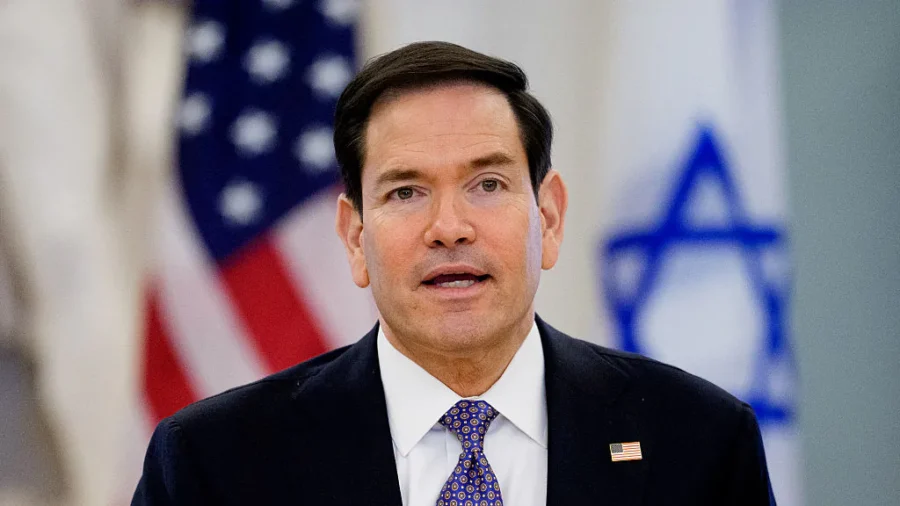
The United States condemned Hezbollah's call for the overthrow of the Lebanese government on May 24.
U.S. Secretary of State Marco Rubio said in a statement that the terrorist group had "ignored repeated calls from the legitimate Government of Lebanon to cease its attacks and respect a ceasefire."
"Instead, it has continued firing on Israeli positions and moving fighters and weapons into southern Lebanon," he said. "This is a deliberate campaign to destabilize the country and maintain its power at the expense of the future of the Lebanese people."
Rubio said that the government in Beirut is working to "deliver recovery, reconstruction, international assistance, and a stable future for its citizens with the full support of the United States," while Hezbollah, in contrast, is "actively trying to drag Lebanon back into chaos and destruction."
The secretary of state went on to say that Washington stood firmly with the "legitimate Government of Lebanon" and that Hezbollah's "threats of violence and overthrow will not be allowed to succeed."
Rubio's statement was issued in response to a televised speech, delivered the same day, by Hezbollah Secretary-General Naim Qassem.
"Sovereignty is about achieving coexistence," Qassem said during the almost hour-long address, broadcast by Hezbollah's media outlet Al Manar.
"If this government is incapable of securing sovereignty, then it should resign. The people have the right to take to the streets, to overthrow the government, and to resist this Israeli–American project with all their might."
The main cause of his criticism of the government in Beirut during his speech was the targeting of the Hezbollah-affiliated Al-Qard Al-Hasan Association, which has the stated purpose of providing interest-free loans to Shia Muslims in Lebanon but has been accused of money laundering and funding the group's terrorist activity.
Since 2007, the Al-Qard Al-Hasan Association has been classified as a specially designated global terrorist by the U.S. Treasury Department’s Office of Foreign Assets Control, and in 2025, the Central Bank of Lebanon explicitly banned all licensed banks, brokerages, and financial institutions from any direct or indirect dealings with unlicensed entities subject to foreign sanctions, citing the association as a prime example. Violators of this ban risk license suspension, asset freezes, or referral for investigation.
Al-Qard Al-Hasan Association branches have been repeatedly targeted by the Israel Defense Forces (IDF) during its recent operations in Lebanon, with Jerusalem considering the institution a key funding vehicle for Hezbollah's terrorist activities.
Both the Al-Qard Al-Hasan Association and Hezbollah deny any funding links between the organizations, and Qassem reiterated this denial in his May 24 comments.
"Hezbollah, if you don't know, transports its funds in suitcases and pays out in cash," he said. "It has no connection to Al-Qard Al-Hasan, not even remotely."
The individuals include named sitting Lebanese government security officers for the first time. The sanctions deny the individuals any access to property or assets in the United States.
The U.S. State Department simultaneously announced a reward of up to $10 million for information leading to the disruption of Hezbollah’s financial networks.
“Hezbollah is a terrorist organization and must be fully disarmed,” Treasury Secretary Scott Bessent said in a statement. “Treasury will continue to take action against officials who have infiltrated the Lebanese government and are enabling Hezbollah to wage its senseless campaign of violence against the Lebanese people and obstruct lasting peace.”
Hezbollah has been designated a foreign terrorist organization under U.S. law since 1997.
The group holds seats in Lebanon’s parliament, operates a vast social services network, and maintains a military wing backed by Iran, making it deeply embedded in Lebanese institutions.