


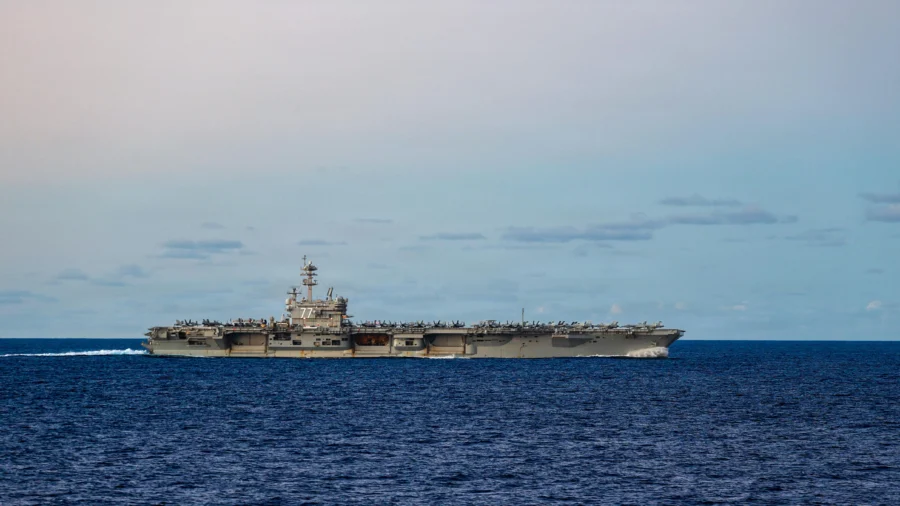
The deployment includes the USS Abraham Lincoln, the USS Gerald R. Ford, and the USS George H.W. Bush, along with their carrier air wings, totaling more than 200 aircraft and about 15,000 sailors and Marines, according to CENTCOM.
"For the first time in decades, three aircraft carriers are operating in the Middle East at the same time,” stated CENTCOM. “Accompanied by their carrier air wings, the USS Abraham Lincoln (CVN 72), USS Gerald R. Ford (CVN 78) and USS George H.W. Bush (CVN 77).”
The three carrier groups include over 200 aircraft and 15,000 Sailors and Marines.
Central Command said this is the first time since 2003 that three carrier groups have operated in the region together, and it is described as "3X STRIKE GROUPS FIREPOWER."
The last time three U.S. carrier strike groups operated in the Middle East in 2003 was a period defined by the U.S.-led invasion of Iraq, which led to the toppling of the Saddam Hussein’s Ba’athist government.
The statement said the carrier strike groups include aircraft such as F/A-18E/F Super Hornet strike fighters, EA-18G Growler electronic warfare aircraft, F-35C Lightning II stealth fighters, E-2C/D Hawkeye early warning aircraft, C-2A Greyhound logistics aircraft, MH-60S/R Seahawk helicopters, and CMV-22B Osprey tiltrotor aircraft.
CENTCOM also listed 12 surface ships supporting the carriers, including destroyers such as USS Spruance, USS Michael Murphy, USS Donald Cook, USS Mahan, USS Winston S. Churchill, USS Frank E. Petersen, USS Mason, USS Ross, and USS Bainbridge.
CENTCOM, one of the War Department’s geographic combatant commands, oversees U.S. military operations across the Middle East, Central Asia, and parts of South Asia.
The carrier deployment comes amid tensions with Iran over shipping lanes and sanctions enforcement, amid the U.S. expansion of maritime operations in the region.
Speaking alongside Joint Chiefs Chairman Gen. Dan Caine, Hegseth said U.S. forces had recently seized two Iranian-linked vessels in the Indo-Pacific that had departed Iranian ports before the blockade took effect.
“They thought they’d made it out just in time. They did not,” Hegseth said, adding that additional seizures would follow.
Officials also described expanded enforcement activity in the Strait of Hormuz, a critical waterway through which roughly 20 percent of global oil and liquefied natural gas shipments pass.
Hegseth said vessels attempting to attack or lay mines in the strait could face immediate military response, stating U.S. forces would “shoot to kill” in such cases.
Gen. Caine said U.S. naval forces have turned back 34 ships attempting to transit the strait and detailed an incident involving a container ship identified as the Touska.
He said the vessel ignored repeated warnings before its engine was disabled after what he described as escalation options, including warning shots. The ship was later boarded by U.S. Marines and taken into custody.
Diplomatic efforts between Washington and Tehran are continuing alongside the military buildup. The White House said Friday that Special Envoy Steve Witkoff and Jared Kushner will travel to Pakistan for further talks with Iranian officials.