


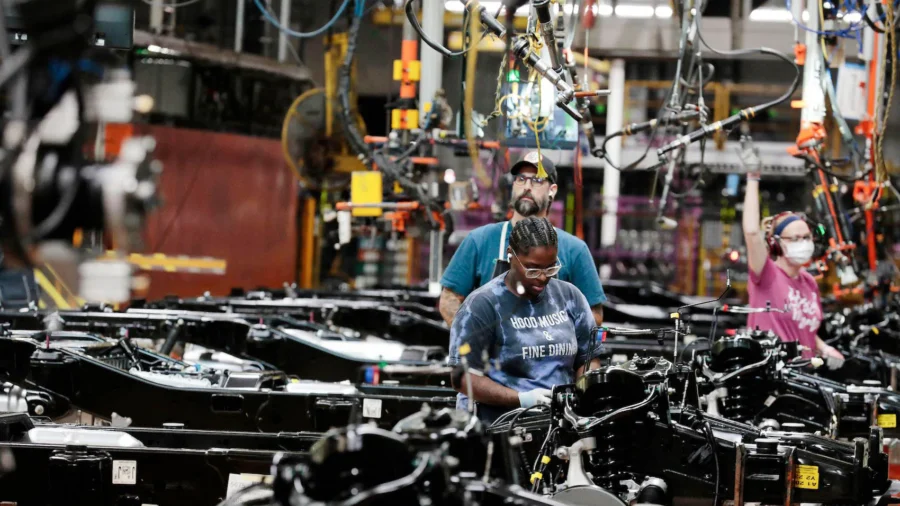
American factory employment sank in July to the lowest level since mid-2020, underscoring a deepening manufacturing downturn driven by dwindling demand and persistent trade policy uncertainty, according to closely watched industry surveys released Aug. 1 by ISM and S&P Global.
“For every comment on hiring, there were two on reducing head counts—a fairly wide ratio, historically speaking—reflecting companies’ continuing focus on accelerating staff reductions due to uncertain near- to mid-term demand,” Susan Spence, chair of ISM’s manufacturing survey committee, said in a statement.
The ISM’s headline manufacturing PMI registered 48.0 in July, signaling contraction for a fifth consecutive month and the sharpest drop since late 2024. All six of the largest manufacturing industries reported weaker new orders, and none saw growth. “Overall, new orders continue to slow amid tariff uncertainty,” Spence said. “Which party will pay tariff costs is still the prime issue in negotiations between buyers and sellers.”
“July saw the first deterioration of manufacturing operating conditions since last December as tariff worries continued to dominate the business environment,” Williamson said in a statement.
As demand stagnated, export orders fell for the first time in three months, and confidence dropped to multi-month lows—leading to firms cutting both inventories and workers.
“Employment consequently fell as factories trimmed headcounts amid concerns over rising costs and lower sales,” Williamson said.
Both manufacturing reports showed that factories continued to face inflation pressures in July, despite weaker demand. The ISM report said input costs remained high, although slightly lower than June’s levels. Similarly, S&P Global highlighted elevated input prices driven mostly by tariffs, but these pressures eased somewhat from recent peaks. Manufacturers responded by raising their selling prices at nearly the fastest pace since November 2022, adding more strain on already slowing demand.
While tariffs function as a tax on imports, the burden is often shared. Foreign exporters tend to absorb part of the cost to preserve access to the U.S. market, and domestic companies also frequently cut margins rather than pass the full increase in prices on to customers.
Bowman noted that economic conditions have slowed but, with pandemic-era memories of worker shortages “still fresh” in the minds of employers, they have resisted laying off workers. She cautioned, however, that unless her colleagues at the Fed proactively lower interest rates soon—as Trump has repeatedly demanded—there’s a risk of “damage to the labor market.”