


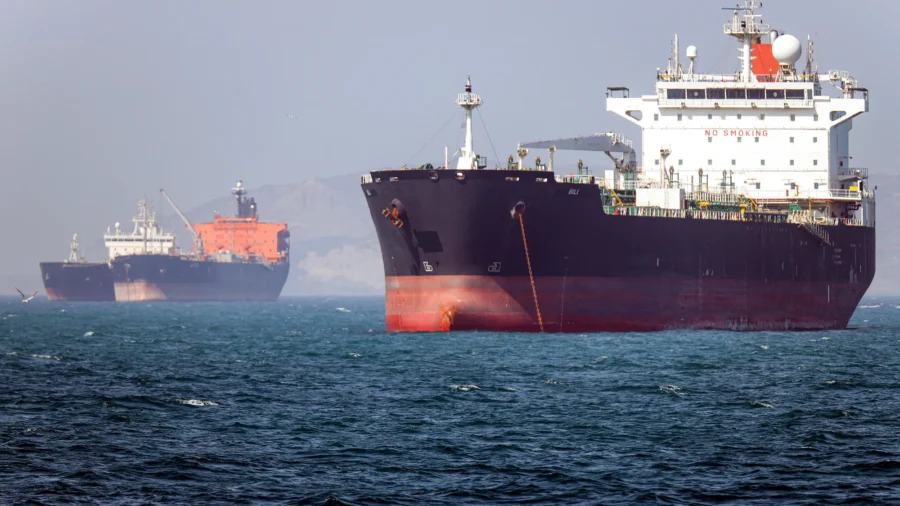
The U.S. military is currently blocking more than 70 tankers from entering or leaving Iranian ports amid the ongoing Middle Eastern conflict.
According to CENTCOM, the blockade continues to remain “fully in effect,” with enforcement action across the Middle East and beyond. Over 15,000 troops, more than 200 aircraft, and 20-plus warships have been deployed to execute this mission.
Blockading Iran’s ports puts pressure on the Middle Eastern country’s economy, as the regime’s major sources of revenue would be affected.
According to an April 13 post by the Foundation for Defense of Democracies, Iran’s crude oil exports would be the “first and most severe casualty.”
“Nearly all of that volume departs via Kharg Island, which handles over 90 percent of crude exports and lacks viable alternative routes outside the Persian Gulf.”
“A blockade would eliminate these flows almost immediately, cutting off the Islamic Republic’s primary source of foreign currency earnings,” it added.
The export of petrochemicals, valued at around $54 million per day, and other non-oil exports, such as minerals and metals, worth roughly $88 million per day, would also be affected, according to the foundation.
Moreover, Iran’s $159 million in daily imports, including food, machinery, and other inputs, would be disrupted, intensifying inflationary pressures in the country.
There has been no indication that the blockade would end soon.
“They trifled with us today. We blew them away,” Trump told reporters while inspecting renovations to the Lincoln Memorial’s reflecting pool in Washington on Thursday.
Oil Price Impact
Amid Iran war uncertainties, oil prices remain elevated. On Feb. 27, a day before the conflict broke out, Brent crude futures closed at around $72 per barrel. On May 8, oil closed at roughly $101 per barrel.“While tensions have escalated, the US has signaled no immediate intent to intensify the conflict and is reportedly still awaiting Iran’s response to a proposal to reopen the trade route,” the bank said, referring to the Strait of Hormuz shipping trade waterway south of Iran that accounts for over a fifth of global seaborne oil trade.
“Looking ahead, oil prices are likely to remain highly headline‑driven, with the recent escalation reinforcing the risk premium. With flows through the Strait of Hormuz unlikely to normalize quickly, markets remain exposed to further upside on any setbacks in diplomatic efforts.”
Despite emergency reserve releases and other measures, the oil market is expected to face a deficit of 3.7 million barrels per day in Q2.
“Even if disruptions ease later this year, oil markets are expected to stay tight in the near future amid ongoing geopolitical risks, uncertain regional flows, and dislocation of shipping assets,” the bank said.
“Look, this is very simple, Iran can not have a nuclear weapon. … And they won’t, and they’ve agreed to that among other things,” the president said.
“Assuming Iran agrees to give what has been agreed to, which is, perhaps, a big assumption, the already legendary Epic Fury will be at an end, and the highly effective Blockade will allow the Hormuz Strait to be OPEN TO ALL, including Iran.”
Operation Epic Fury, against the Iranian regime, began on Feb. 28.