

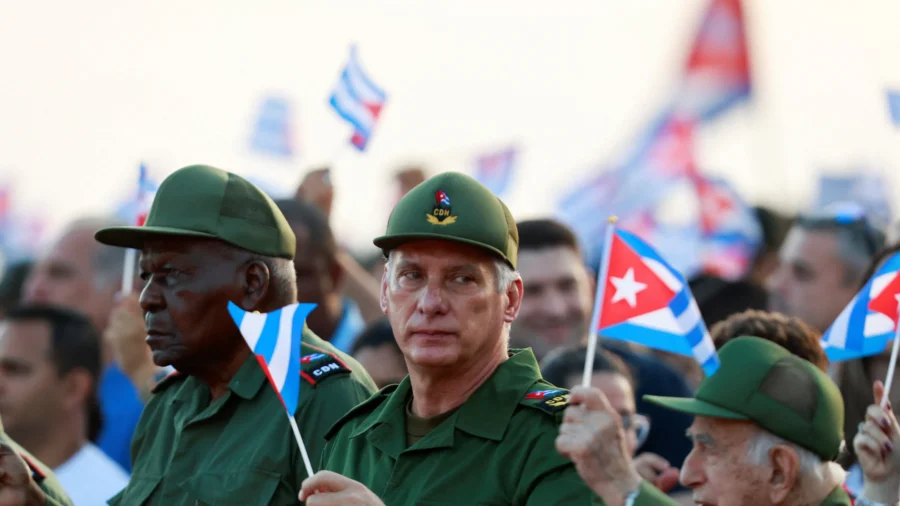
Alejandro Castro Espín, son of former leader Raúl Castro, and Castro Espín’s son are also included in the sanctions. They also apply to Cuba’s defense ministry, the Institute for Friendship with the Peoples, the official travel agency Amistur Cuba, and the Committees for the Defense of the Revolution, according to public filings.
“The country is starving, and it’s got no energy, it’s got no oil, it’s got no money, it’s got nothing. It’s got a beautiful piece of land,” Trump said Thursday at an Oval Office event. “You could have beautiful resorts.”
Trump was asked about whether or not the country could collapse.
“It’s sort of collapsed,” he said, adding that “we’re going to handle that as soon as we’ve finished” other priorities.
“I like to do one thing at a time,” he said.
U.S. Secretary of State Marco Rubio, whose family has Cuban roots, has said that the sanctions are necessary and that Cuba poses a national security threat.
“Those designated today direct or fund the regime and its efforts to mobilize its radical revolutionary movements in the United States and around the world,” Rubio said in a statement.
“This political blindness adds to the coercive measures applied in recent weeks against our country, designed to harm the Cuban people.”
He accused the United States of “new threatening statements against Cuba” and promised resistance “to confront the worst-case scenarios and resist the imperial onslaught.”
“Every U.S. action aimed at creating a scenario of conflict between the two countries is destined to fail,” Rodriguez said in a translation from Spanish. “Every threat against Cuba’s independence and sovereignty will be met with even greater unity and determination from our people.”
Díaz-Canel, who succeeded Raúl Castro in 2018, has presided over worsening crises. His wife, Lis Cuesta Peraza, functions in a first-lady role and faces sanctions alongside her stepson, Manuel Anido Cuesta.