


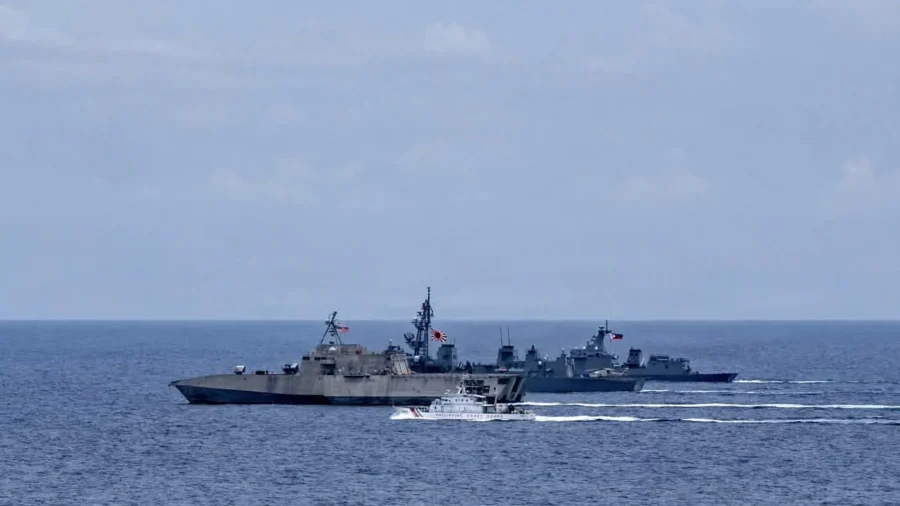
U.S., Japanese, and Philippines forces completed a five-day maritime exercise in the South China Sea on July 25, a day after an attack in disputed waters intensified tensions between the Filipino government and Chinese communist regime.
The Armed Forces of the Philippines said on Sunday that the joint drills included working together on communication exercises, division tactics, cross-deck landing, and fly-by operations.
The efforts help “the enduring partnership among the partner nations in promoting peace, stability, and security in the Indo-Pacific region,” the Philippines Armed Forces (AFP) wrote in a statement on July 26.
“It likewise reflects the AFP's continuing commitment in ensuring freedom of navigation and overflight while deterring illegal, coercive, aggressive, and deceptive activities in the West Philippine Sea,” it added.
The exercises, called the 17th Multilateral Maritime Cooperative Activity, were held from July 21 to 25.
The exercises overlapped with a separate training exercise between the U.S. Navy and Japan Maritime Self-Defense Force, as forces participated in mine warfare training off the coast of northern Japan in Mutsu Bay from July 9 to 24.
“It is always an honor and a privilege to work alongside our host-nation partner and continue to build on our powerful relationship within the mine countermeasures community,” U.S. Navy Capt. Scott G. Wells said, adding that the U.S. military has been conducting these exercises with the Japan Maritime Self-Defense Force “for decades, and we remain dedicated to advancing our collective capacity in this critical operational capability.”
The incident happened in the South China Sea near Second Thomas Shoal, a submerged reef that both China and the Philippines claim.
According to the Philippine Coast Guard, China fired a water cannon at Philippine government ships near the Scarborough Shoal, another disputed area, on both Thursday and Friday during the drills.
The Chinese Embassy in Manila denied the claims and suggested their personnel were provoked.
The sources say the military drills should not necessarily be viewed as an isolated event, as China may want to signal that Chinese military movements happen often.