


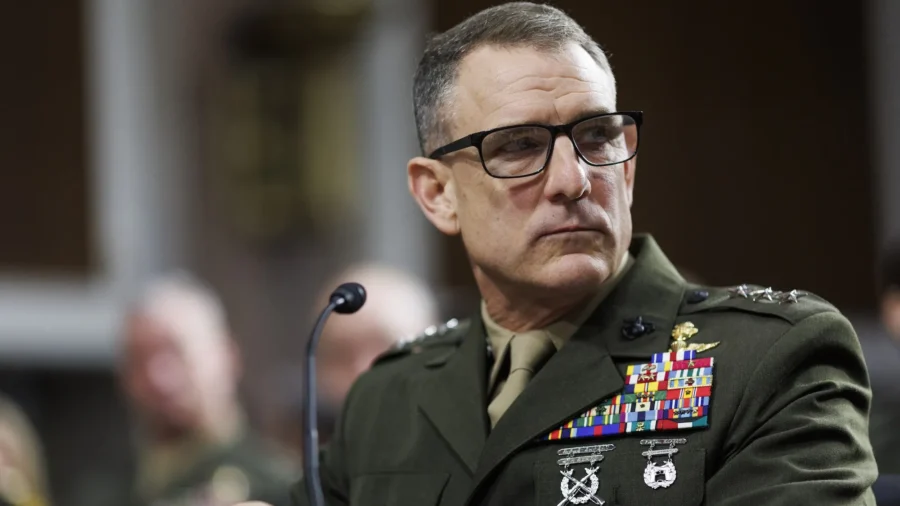
The U.S. military is not rehearsing for an invasion of Cuba or actively preparing to take over the island, the general in charge of American forces in Latin America told lawmakers in Washington on March 19.
Gen. Francis Donovan, head of U.S. Southern Command, said the United States is ready to defend its naval base at Guantanamo Bay in Cuba, to address any threats to the U.S. embassy, and to support White House efforts to address any mass migration from the island, if needed.
Asked whether the U.S. is rehearsing military operations that involve seizing, occupying, or otherwise attempting to control Cuba, Donovan replied, “U.S. Southern Command is not.”
Asked whether he knew of any other U.S. military command doing so, Donovan responded, “No.”
Donovan made his comments during a Senate hearing focused on President Donald Trump’s use of the U.S. military in Latin America, following January’s operation to capture Venezuelan leader Nicolás Maduro, who is charged with narco-terrorism offenses. He denies the charges.
‘The Honor of Taking Cuba’
Trump told reporters on 16. March that he anticipated having the honor of taking the island.“I do believe I’ll be having the honor of taking Cuba. That’s a big honor, taking Cuba in some form,” Trump said during an executive order signing at the White House. “Taking Cuba. I mean, whether I free it, take it, I think I can do anything I want with it.”

Energy Shortages
Trump has piled mounting economic pressure on Cuba by stopping all Venezuelan oil shipments to the island nation, leading to severe energy rationing.On March 16, Cuba’s electricity grid went down, leaving its 10 million residents without power.
Donovan said at the White House hearing that Guantanamo Bay needed fresh investment from Washington after suffering from storm damage.
“I won’t pull any punches, it’s in rough shape,” Donovan said of the naval base, where President George W. Bush established a detention camp in 2002 to hold suspects following the Sept. 11, 2001, terrorist attacks against the United States.
The naval base has been leased by the United States from Cuba since 1903.
“Because of the hurricane damage, we’re down to one working pier and one refueling pier. I believe [the base] is a pivotal point for any operations in the Caribbean,” Donovan added.

Guantanamo Could House Cuban Migrants
Donovan said the Department of Homeland Security, which oversees the U.S. Coast Guard, would take the lead in the event of any such mass migration.He did not dismiss the possibility of setting up a camp at Guantanamo Bay to house an overflow of Cuban migrants.
Asked what action U.S. forces were prepared to take to safeguard the security of Americans in Cuba, Donovan said, “If it developed into a physical security threat to the U.S. embassy or the base at Gitmo, we would put U.S. troops [there] to defend American lives.”
Óscar Pérez-Oliva Fraga, Cuba’s deputy prime minister and minister of foreign trade and investment, told NBC News in an interview published on March 16 that Cuban nationals residing overseas—including those in Miami—will be permitted to participate directly in the island’s emerging private economy.
“Cuba is open to having a fluid commercial relationship with U.S. companies,” Fraga said in a sit-down interview in Havana. “Also with Cubans residing in the United States and their descendants.”
The announcement marks a potentially significant shift for the island nation, which for decades, since the communist takeover, has tightly restricted private ownership and outside investment.