


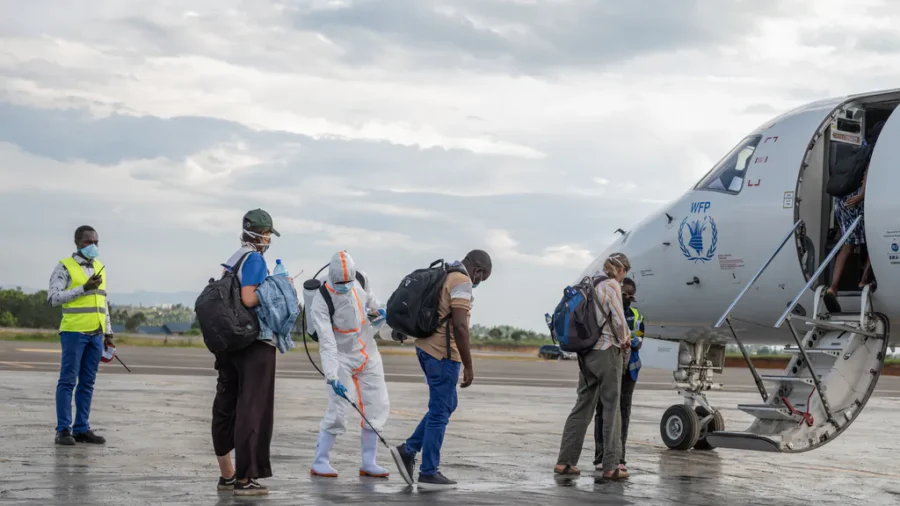
The U.S. Department of State announced the updated procedures on June 2. The new guidance details steps available to U.S. citizens based on their level of Ebola exposure and whether they are experiencing symptoms.
Under the policy, Americans assessed as not at high risk of Ebola exposure may receive assistance from embassy personnel, including help coordinating departure from the affected country and, in some cases, loans if needed.
Americans considered to be at high risk of exposure—but not yet showing symptoms—may be transported to a medical facility in Kenya for a 21-day quarantine, starting from the date of their last possible exposure.
The State Department said these individuals will receive care from U.S. medical professionals. If symptoms develop during quarantine, specialized aeromedical evacuation may be arranged for immediate treatment.
For Americans considered high risk and either symptomatic or testing positive for Ebola, the State Department said it may arrange specialized medical evacuation to a designated location for treatment.
Participation in the program is voluntary, according to the State Department.
However, it adds that “those who decline U.S. assistance will continue to be subject to relevant U.S. government and host country health, travel, and screening measures.”
Americans seeking help are urged to contact the nearest U.S. Embassy or the Centers for Disease Control and Prevention (CDC).
As of May 28, travelers who were present in any of these countries within 21 days prior to arriving in the United States must enter through designated airports for enhanced health screening.
The designated airports are Washington Dulles International Airport, Hartsfield-Jackson Atlanta International Airport, George Bush Intercontinental Airport in Houston, and John F. Kennedy International Airport in New York.
Screening at the airports includes health questionnaires, temperature checks, observation by CDC staff, and collection of contact information for possible follow-up by public health authorities.
In addition to airport screenings, the United States temporarily banned non-U.S. citizens who have recently traveled to the Democratic Republic of the Congo, Uganda, or South Sudan from entering the United States.
The Department of Homeland Security extended these restrictions on May 22 to include lawful permanent residents, or green card holders, who visited those countries within the past 21 days. Those individuals are also temporarily prohibited from entering the United States, officials said.
WHO also counted 906 suspected cases and 223 suspected deaths in Congo as of May 27. Among the confirmed cases is a U.S. health worker who treated patients in Congo and is receiving care in Germany.