


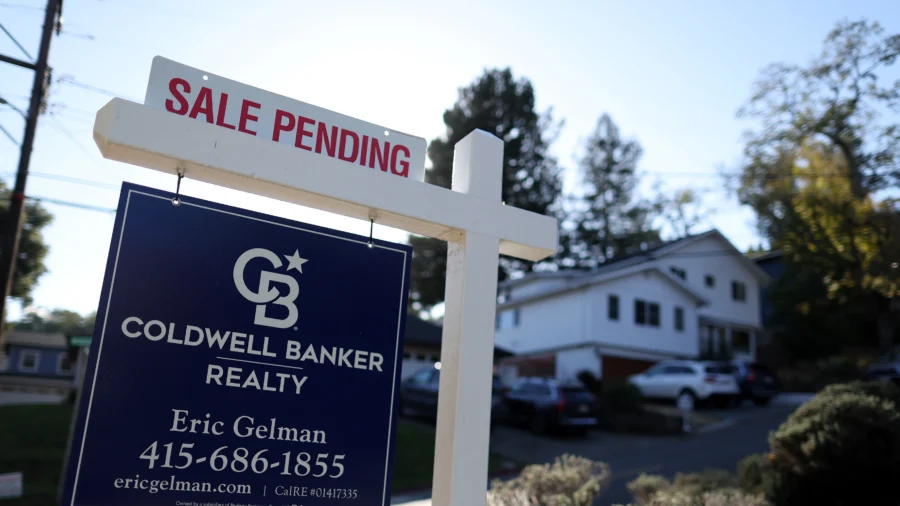
Pending home sales in the United States grew by 7.7 percent year over year for the four weeks ending May 3, hitting the highest level since September 2022, according to a May 7 statement from real estate brokerage Redfin.
Pending home sales refer to home purchase contracts that have been signed but not yet closed, and can be used as an indicator of future existing home sales. After signing the contract, it can take anywhere from four to eight weeks for a home sale to close.
Redfin attributed the jump in pending home sales to a higher number of properties for sale on the market, a temporary dip in housing costs, and seasonality kicking in later than typical.
“The total number of homes for sale rose roughly 1 percent year over year to near their highest level in at least five years. When there are more homes to buy, there are more sales,” the company said.
“Spring is typically the busiest time of year for the housing market: A recent Redfin analysis found that late April is the best time of year to list a home for sale because homes are more likely to sell above their asking price, and to sell quickly. The big uptick in seasonally adjusted pending sales could signal that spring homebuying season is starting late.”
Regarding housing costs, the median housing payment declined 2.2 percent year over year as mortgage rates fell.
Last year, the average weekly rate for a 30-year fixed-rate mortgage hit an annual high of 7.04 percent, according to data from Freddie Mac. For the week ending May 6, rates were at 6.37 percent. Rates fell below the 6 percent level in late February.
Despite the spike in pending sales, the current housing market is “slower and less competitive” compared to the previous spring seasons, Redfin said. Only 26.4 percent of homes that go under contract are being sold above the asking price, which is at least a five-year low.
“Some homes are attracting multiple offers, but only those that are priced fairly and have been updated,” said Ashley Arzer, a Redfin Premier agent in Chicago.
“A new kitchen and new bathroom are the ticket to a bidding war. Older homes that need repairs, and those far above the most popular price range—around $400,000 in Chicago—are taking longer to sell.”
As for actual home sales, a May 6 statement from real estate marketplace Zillow said that sales recovery stalled in April following stronger sales figures in March, attributing it to higher mortgage rates. In March, the weekly rates had risen from around 6 percent to roughly 6.4 percent, with April rates remaining above 6.2 percent.
Despite the slight recent increase in mortgage rates, the monthly mortgage payment on a typical home declined 3.4 percent on an annual basis to $1,829 in April.
“Slightly friendlier conditions for buyers point to the chance of a quick rebound if rates fall back to the 6 percent range seen earlier this year,” Zillow said.
New Home Sales
In a May 5 statement, the National Association of Home Builders (NAHB) said that sales of newly built single-family homes jumped 7.4 percent in March.NAHB Chairman Bill Owens said the uptick in new home sales was a reflection of improving demand conditions due to ongoing supply constraints in the existing home market and lower mortgage rates.
“Builders are gradually increasing production, but elevated construction costs and labor shortages continue to limit the pace of expansion,” Owens said.
Danushka Nanayakkara-Skillington, NAHB’s assistant vice president for forecasting and analysis, said that the outlook “remains sensitive to interest rate movements and affordability conditions, which will ultimately determine the sustainability of this momentum.”
On May 4, HUD announced updating some of the environmental review requirements to lower the “costs and complexity” for multifamily property developers and lenders.
HUD and the Department of Agriculture on April 28 rescinded a policy related to Minimum Energy Standards applicable to newly built single-family and multifamily homes.
Enforcing the energy standards would have raised home construction costs by $20,000 to $31,000, HUD said. This could have pushed new homes out of reach for many first-time buyers.