


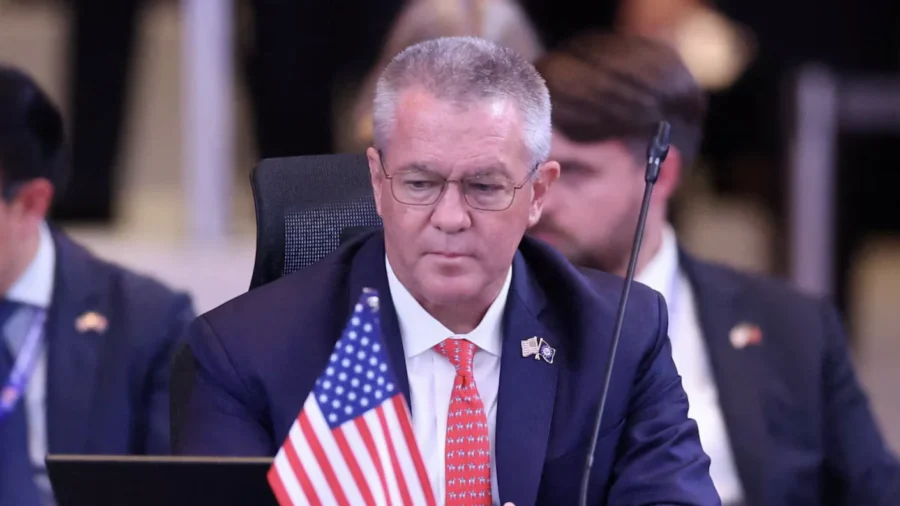
A top U.S. official reaffirmed that its longstanding policy toward Taiwan remains unchanged during a congressional hearing on Thursday.
“Our long-standing policy on Taiwan has not changed,” DeSombre said. “We remain committed to preserving peace and stability across the Taiwan Strait and oppose any unilateral change to the status quo.”
However, President Donald Trump’s interaction with China’s leader Xi Jinping has raised alarm among some lawmakers. Trump told reporters on Air Force One after departing Beijing following his summit with Xi that he had discussed U.S. arms sales to Taiwan with Xi “in great detail.”
Rep. Johnny Olszewski (D-Md.) asked if Trump’s stance sounded like “a pretty alarming and blatant violation of those six assurances.”
DeSombre said that whenever there is a meeting with China, they raise the questions of Taiwan and arms sales. “So it's something that is always discussed with them. But that is not in any way a deviation from the six assurances."
His remarks came during a hearing focused on implementing an “America First” approach in the Indo-Pacific region, emphasizing that Washington remains committed to preserving peace and stability across the Taiwan Strait.
The Six Assurances, first articulated in 1982, make clear that the United States has not agreed to set a timeline for ending arms sales to Taiwan, will not consult Beijing on such sales, and will not mediate between Taipei and Beijing.
The hearing underscored strong bipartisan support for Taiwan at a time when Beijing has intensified political and military pressure on the self-governed island. Chair Young Kim said Taiwan, as the United States’ “critical democratic partner” is facing unrelenting pressure from Beijing, and “the future of Taiwan must be decided by its people, not Beijing.”
The Trump administration approved a historic $11 billion arms package for Taiwan last December, the largest ever, while a separate $14 billion follow-on package is currently under review.
“The 11 billion is more than the entire amount that was approved under the prior administration. It represents a real sea change,” DeSombre said, but he could not give a timeline for the new package. “The 14 billion is currently under review by the president and the president will determine when that happens.”
Lawmakers also emphasized the importance of Taiwan strengthening its own defenses. While Taipei recently approved a $25 billion supplemental defense budget, some members expressed concern that it did not sufficiently prioritize advanced capabilities, such as unmanned systems.
DeSombre said the State Department is actively encouraging Taiwan to allocate additional resources toward such investments, and “there are various different bills under consideration currently by the legislative yuan in Taiwan.”