


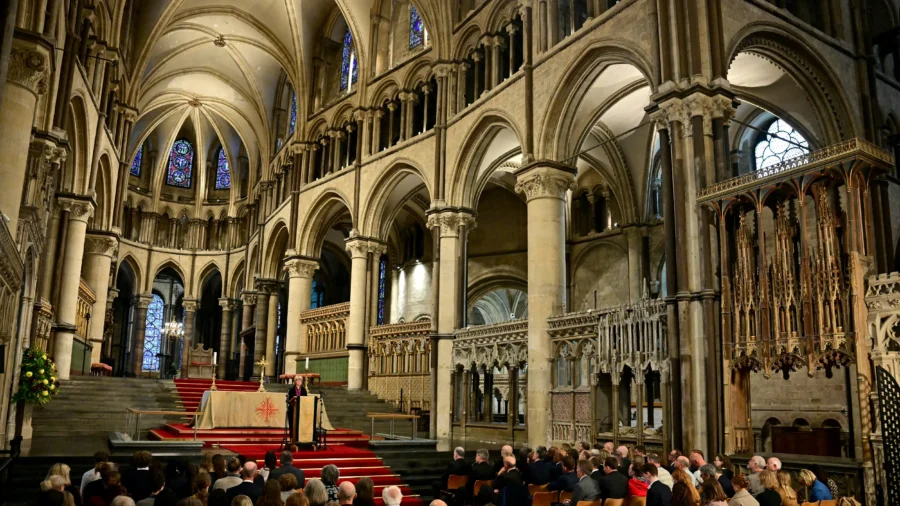
The decision to mark the walls of the UK's historic Canterbury Cathedral with graffiti faced staunch international criticism on Oct. 10, as the Church of England’s attempt to appeal to marginalized communities has been criticized as ugly and inappropriate.
Titled “Hear Us,” the temporary art installation is set to open on Oct. 17 and remain open through January 2026.
Visitors will find graffiti spread across the walls and pillars of the 1,400-year-old cathedral as they would on the side of city buildings.
Questions chosen to tag the walls included “Are you there?” “Why did you create hate when love is by far more powerful?” and “Do you ever regret your creation?”
The cathedral acknowledged that some visitors disapproved of the exhibit, noting one deemed it “sacrilegious.” Yet it stood by the exhibit, with the Dean of Canterbury, David Monteith, the chief resident cleric of Canterbury Cathedral, saying that the art “builds bridges between cultures.”
The criticism has gone international, attracting the ire of leaders regardless of religious affiliation.
Vice President JD Vance, a practicing Catholic, spoke out against it.
Elon Musk, who has described himself as a cultural Christian, replied to Vance’s post simply saying, “Absolutely.”
Rev. Gavin Ashenden, a recent Catholic convert after serving as a chaplain to Queen Elizabeth II, also rebuked the exhibit.
Disciples of Christ, a self-described UK Christian protest group, also spoke out.
The exhibition is scheduled to close just before the official ceremony that will recognize Dame Sarah Mullally as the 106th—and first female—Archbishop of Canterbury.
Several voices on social media connected Mullally’s appointment and the graffiti installation as two signs of the same direction away from the centuries-old traditions and beliefs of the church. Critics have called out Mullally’s liberal positions on LGBT, abortion, and immigration matters.
Her appointment alone sparked the Nigerian Church’s decision to end its communion with the Anglican Church. They also pointed out that Monteith is an openly gay man, and that Vellis self-describes as nonbinary.
Rev. Ben Johnson, an Orthodox priest in the UK, contrasted the crude graffiti posted next to an example of the reverent iconography known to populate cathedrals.
"The Orthodox Church’s proper iconography—of the sanctuary or the priesthood—has never been more important.”